Highlighting the thinkers and their ideas driving the evolution of Offsite Construction. 
Be inspired, be informed, be innovative!

Where Profit Really Slips Away: The Hidden Moments That Decide a Factory’s Fate

In modular and offsite construction, profit isn’t made when the last module leaves the factory—it’s made (or lost) in the hundreds of smaller moments that happen long before that. Most factory owners know their gross margin target, but few can tell you precisely when and where that margin starts to slip off the table.

It Starts Long Before the Floor

Walk into any offsite construction factory and you’ll see order, efficiency, and the hum of production. But the story of profit doesn’t begin there. It begins weeks or even months earlier in the estimating and quoting process, where a single optimistic assumption can plant the seed for future losses.

Many estimators still rely on outdated spreadsheets or supplier pricing from three months ago. They assume consistent labor productivity or fail to add contingency for one-off designs. Then, when the project is awarded, everyone breathes a sigh of relief—until the first purchase order shows materials that cost 8% more than quoted.

It’s not the factory floor that breaks the budget. It’s the estimate that was never stress-tested against reality.

Benchmark Moment #1: Compare your original labor and material estimates against actuals after the first two weeks of production. If you’re already running more than 5% off in either category, you’ve just seen your profit margin’s first crack.

Contracts Without Protection

In today’s volatile material market, locking into a fixed-price contract without an escalation clause is like walking a tightrope without a net. One shift in steel or lumber prices, or even a change in freight costs, and the project moves from black to red ink overnight.

Some factories still sign long-term projects without including an escalation clause or shared-risk adjustment for major materials. That may keep a client happy in the short term, but it leaves the factory absorbing all the market risk.

Factories that have learned this lesson the hard way now add a line or two that protects them—either tying prices to an index or stipulating a review if material costs rise beyond a threshold.

Benchmark Moment #2: Track project launch dates versus original quote dates. If production starts more than 90 days after the quote, review every cost line item again. Inflation waits for no one.

Design: The Quiet Profit Thief

Between the quote and the factory floor lies another trap—the design-to-production handoff. This is where even the most profitable-looking project can unravel.

Every time a design team issues a new drawing after release to production, it costs money. A missing framing detail, a late electrical layout, or a window specification change may look minor, but when it hits five modules on the line, it means downtime, confusion, and rework.

Factories that promote “design for manufacturability” have learned that profit protection starts with a disciplined pre-production process. One manager told me, “Every revision is a dollar sign. The fewer changes, the higher the profit.”

Benchmark Moment #3: Track the number of design changes after release to production. More than two changes per module type is a flashing red light.

The Floor: Efficiency vs. Throughput

Once a project hits the production line, the profit equation becomes a race between speed and waste.

The temptation is to judge success by output: “We shipped four modules today.” But throughput without efficiency is deceptive. If those modules took overtime hours, excessive material movement, or required rework at the finish line, the factory may have shipped its profit right along with them.

What separates strong factories from struggling ones is real-time visibility. When management knows daily takt time per station, total labor hours per module, and scrap percentage, they can spot small deviations before they turn into margin erosion.

Factories that rely on weekly or monthly summaries discover the truth far too late. By then, the money is gone.

Benchmark Moment #4: Review overtime hours as a percentage of total labor. Anything over 10% should trigger a meeting. It’s not just a payroll problem—it’s a process problem.

Supply Chain Slipups

The next profit leak often comes from the supply chain. A late delivery of insulation or an incomplete cabinet order can halt an entire line. When that happens, crews still clock in, but production stops.

Every hour of idle time is unrecoverable. Yet many factories don’t categorize downtime in a way that exposes its real cost. They track “line delay” but not why—and without the why, you can’t prevent the next one.

Progressive factories now use dashboards that tag every downtime minute by cause: missing materials, design issues, equipment failure, or labor shortages. Within a month, patterns emerge. That’s when management can start plugging the holes instead of guessing where they are.

Benchmark Moment #5: Track downtime cost per module. If unplanned downtime exceeds 3% of total project labor, you’re losing profit faster than you realize.

The Late-Stage Surprise

By the time the accounting department raises the alarm, the problem has already spread through multiple departments. The project’s done, but the margin is gone. It’s at this stage many factories say, “We’ll learn from this next time,” but rarely build systems to catch it earlier.

Profit protection requires an early-warning culture. That means supervisors, estimators, and managers must all have visibility into live data—not just production stats, but real financial impact.

When everyone understands how a missed delivery, an extra day on the line, or an underbilled change order affects profit, accountability becomes collective rather than reactive.

Benchmark Moment #6: Hold weekly 20-minute “Profit Pulse” meetings with estimating, production, and accounting. Review current variances and adjust before it’s too late.

Profit Awareness Is a Mindset

Here’s the uncomfortable truth: many factories aren’t losing money because they’re inefficient—they’re losing it because they’re unaware.
They have the data, but it’s trapped in different systems: estimating software, accounting programs, or spreadsheets no one updates.

A profitable factory doesn’t just measure output; it measures awareness. When every manager can see in real time whether they’re ahead or behind the margin curve, behavior changes. Suddenly, that extra 20 minutes of overtime matters. The missing pallet of drywall matters. The vague design note matters.

Profit protection stops being a finance department function and becomes a shared responsibility—just as it should be.

Catching It Early

When I ask general managers when they realized a project would lose money, I usually hear, “Near the end.” By then, it’s too late to fix. But if that same manager had seen a live variance report two weeks in—when labor ran 15% over target or material waste jumped by $600 per module—they could have intervened before the slide became a plunge.

Factories that catch problems early don’t do it with magic—they do it with systems. Dashboards, variance tracking, and tight coordination between estimating, production, and accounting are their lifelines.

When the warning lights flash, they act immediately. Not next month. Not when the project closes. Right now.

The Real Benchmark

Ultimately, the most important benchmark isn’t financial—it’s cultural.
Does your team care enough to ask, “Where’s our margin today?”
If they do, you’ve built a factory that understands that profit is a process, not a number.

Because in offsite construction, the moment someone says, “We’ll figure that out later,” that’s the exact moment profit starts walking out the door.

My Final Thought:
Profit doesn’t vanish in one bad decision—it slips away quietly, one overlooked estimate, one untracked hour, one missing clause at a time. The factories that survive and thrive are those that listen for those whispers early enough to act on them.

Because by the time you can see the problem clearly… it’s already costing you money.

If you’d like to explore this further, connect with us today.

My Modular Factory Music Playlist of Problems

Every offsite and modular construction factory has its own soundtrack—though it’s not always the one you want to hear. The clanging nail guns, the hum of saws, and the steady rhythm of forklifts backing up all make for an industrial symphony. But if you listen closer, you can almost hear songs that fit each major factory problem perfectly.

So, I made a playlist—five songs from my era, about 15 minutes total—that sum up the highs, lows, and daily chaos of modular construction life.

Problem: Constant production delays

Every factory hits a slump. Maybe the next module’s missing windows, the truss supplier’s behind, or the line’s been stopped since Tuesday because the forklift battery died. Whatever the reason, this anthem captures the one thing every modular team needs—unshakable optimism.
When you’re staring at a whiteboard full of red deadlines, crank this up and remind yourself: success in offsite isn’t a sprint; it’s a slow dance with logistics.

Problem: Design-engineering miscommunication

Ever had a BIM file that didn’t match the factory’s build sheet? Or a bathroom pod that somehow ended up one inch too wide for the truck? Zeppelin nailed that chaos in two and a half minutes. It’s the perfect soundtrack for the moment a factory supervisor yells, “That’s not what the architect drew!”
Pure, beautiful mayhem—and the anthem of every engineer who’s ever had to issue a “revision B” in record time.

Problem: Cash-flow crunch

Payroll’s due Friday. Your next draw hasn’t cleared. You’ve got 18 homes in production and 3 stuck in inspection limbo. Cue the pounding piano and frantic lyrics. Every modular startup founder has lived this song at least once.
“Money don’t get everything, it’s true…” Yeah, except material shipments, factory leases, and payroll. In our world, it’s always about timing the cash to match the chaos.

Problem: Factory morale and burnout

This one’s for the production floor—the men and women who swing hammers, cut panels, and keep the modules moving no matter how hot, cold, or complicated the day gets. The long solo is the perfect metaphor for that endless rhythm of work and pride.

When morale dips or someone says, “This job’s too hard,” play this loud enough to shake the siding rack. You’ll see a few heads nodding. Every modular worker is the working man.

Problem: Over-hyped innovation that fails in the field

Every few months, another “game-changing” modular startup appears—promising to disrupt the industry. And just as quickly, another one quietly folds.
Queen’s bass line is the sound of reality catching up. The startups that survive aren’t the flashiest or the loudest; they’re the ones that learn from every missed nail and cracked panel.
“Out of the doorway the bullets rip…” Yep—sometimes that’s just investor feedback.

The Encore: Why It Matters

Music is emotion, and modular construction has plenty of it. Every factory owner, plant manager, or builder could probably add their own verse to this playlist. The point isn’t just to laugh—it’s to remember that these challenges are universal. The key is to keep your rhythm, stay on tempo, and never stop believing (literally).

So next time your schedule slips, your drawings clash, or your budget gasps for air—turn on this playlist. Because sometimes, the only way to stay sane in modular construction is to sing your way through it.

The Skilled-Labor Crisis Ford’s CEO Is Sounding the Alarm On

It’s not a someday problem—it’s a now problem. Ford CEO Jim Farley has been warning that the shortage of skilled tradespeople is already choking the nation’s “essential economy.” He’s talking about construction workers, electricians, machinists, and auto techs—the people who physically make and maintain everything that keeps our society running. Without them, no amount of AI or robotics will matter.

Between persistent inflation and this mounting shortage, the United States is heading toward a dangerous collision: fewer workers, slower production, and rising costs on nearly every consumer good.

Farley’s Take: What’s Really Going On

Inside Ford, the need for skilled workers has turned urgent. Farley says they’re thousands of technicians short across the dealership network. You can’t reshore factories or scale domestic manufacturing if there’s no one left to operate or repair them. He sees a cultural blind spot, too. Society has undervalued hands-on careers, even though many offer strong pay and purpose.

Farley’s own son once worked as a mechanic and came away wondering if college was really necessary—proof that meaningful work is out there if we stop discouraging it.

Technology, in his view, is not the enemy. He calls augmented reality and AI-based tools “game changers” that could make technicians more efficient, safer, and better trained. But without people willing to learn those tools, factories and job sites risk becoming high-tech shells with no one to run them.

Farley’s frustration extends to policy. He argues the nation has underinvested in vocational education for decades, treating it like a side project instead of a strategic necessity. He believes funding workforce development should rank alongside infrastructure and defense, because the cost of inaction is already visible in delays, shortages, and lost competitiveness.

Why This Drives Prices Up—And Why You’ll Feel It

The math is brutal. When fewer skilled people can produce goods, output slows. Slowdowns shrink supply, and when supply drops, prices rise. Layer on inflation that’s already baked into materials, transportation, and energy, and companies have no choice but to pass costs to consumers.

Farley warns that productivity gaps between white-collar and blue-collar sectors are widening. The “essential economy”—the one that welds steel, pours concrete, and repairs trucks—isn’t keeping pace. If we can’t build efficiently at home, we’ll rely more on imports, stacking on logistics fees, tariffs, and foreign labor costs. In plain language: everything from houses and cars to appliances and infrastructure will get pricier.

Farley’s Prescription: What the U.S. Must Do—Now

Farley says we need to treat worker development the same way we treat roads or bridges. That means serious national funding for modern vocational schools, apprenticeships, and tech-integrated training programs that combine coding with machining and robotics with carpentry. He’s pushing for incentives—grants, tax credits, even loan forgiveness—for young people entering trades instead of four-year degrees that leave them buried in debt.

Technology should support, not replace, labor. Deploying AR and AI tools can make learning faster and jobs safer, attracting a generation that’s fluent in digital tech. Farley also calls for slashing red tape around factory expansions and public projects; bureaucracy can’t be allowed to stall progress when labor is already scarce.

Most importantly, he wants a cultural reawakening that restores pride in building things. Skilled trades aren’t second choices—they’re national assets.

Jim Farley’s Final Word

America’s dreams of reshoring, AI-powered manufacturing, and modern infrastructure hinge on a workforce we’re failing to replenish. Inflation and the labor gap are converging into a perfect storm that could make high prices and long delays the new normal.

If we want to stay competitive, we must act like makers matter—because they do.

ERP vs. MES: Why Offsite Factories Need Both to Win

How Moducore and 4Ward Solutions keep your business and factory in sync

Walk into any offsite construction factory and you’ll see two very different worlds. Up front, the business office is quoting jobs, managing finances, ordering materials, and scheduling deliveries. Out on the floor, saws are humming, stations are building walls or modules, and supervisors are racing to hit daily goals.

Both sides have one thing in common: they need accurate, real-time information. That’s where ERP and MES systems come in — and understanding the difference between them is key to building a factory that runs on time, on budget, and with no surprises.

ERP: The Business Brain

An Enterprise Resource Planning (ERP) system is the strategic planner. It’s built to manage everything that keeps your business alive and profitable — quoting, purchasing, payroll, job costing, and project tracking.

In the offsite world, Moducore is the only ERP platform purpose-built for modular and component construction that unifies estimating, procurement, production planning, lifecycle BOMs, MRP, shipping, and customer handoff — in a single platform. Unlike generic ERPs, Moducore connects directly to floor activity through integrated production cards, material requisitions, and WBS-driven scheduling.

With an ERP like Moducore, you can answer questions like:

  • How much profit am I making on each job?
  • When should I reorder materials?
  • Are my projects running ahead or behind schedule?
  • What do my next six weeks of cash flow look like?

Think of ERP as your executive command center. It sees the big picture and makes sure every project aligns with your financial goals.

MES: The Factory’s Nervous System

While ERP looks at the horizon, the Manufacturing Execution System (MES) focuses on what’s happening right now on the factory floor.

That’s where 4Ward Solutions Group’s FactoryOS MES shines. It’s built by people who’ve worked in modular factories and understand the chaos that can unfold when information lags behind the work.

4Ward’s MES monitors every step of production — which stations are active, where delays are forming, what materials are missing, and how each module or panel is performing against the plan. It also tracks cycle times, downtime, quality checks, and rework — giving managers instant visibility into bottlenecks.

With MES in place, you’ll know:

  • Exactly where every job is on the line
  • Who’s working on what — and how efficiently
  • When a station needs materials before it runs out
  • How to balance workloads across multiple lines

It’s like having eyes on every square foot of the shop — without running around trying to find answers.

Why You Need Both

Some factory owners ask, “Can’t I just use one system?” The truth is, ERP and MES speak two different languages — and together, they create a powerful feedback loop.

  • ERP says: “Build 20 modules for Project Alpha. Here’s the budget, the schedule, and the material order.”
  • MES responds: “Station 3 is 20 minutes behind; insulation shortage at Station 5; Module 14 passed inspection.”

Then Moducore’s ERP updates project timelines, recalculates cost projections, and automatically alerts purchasing through MRP-driven triggers — giving your team immediate insights into what to do next. The result is not just tighter control, but a real-time response loop between financial planning and factory execution.

When these two systems talk to each other — as Moducore and 4Ward Solutions can — your business operates with real-time clarity from quote to completion.

A Real-World Example

Imagine you’re building 40 modules for a new apartment project. Moducore schedules the job, orders the materials, and builds a timeline that fits your client’s delivery date.

As work begins, 4Ward’s MES tracks every module through the factory. If one station falls behind or a material runs short, you get notified instantly. The MES feeds this data back into Moducore, which updates the schedule, flags the cost variance, and prompts a purchase order.

No paper travelers. No guessing. No missed deadlines.

The Smart Factory of the Future

Factories that run only on ERP may plan well but stumble in execution. Those running only MES may build efficiently but lose control of profitability. The real winners are those that combine both, linking the boardroom to the shop floor with live data and clear accountability.

With Moducore guiding your business strategy and 4Ward Solutions powering your factory execution, you’re not just building homes — you’re building a smarter, leaner, more predictable company.

Bottom Line

In offsite construction, success comes from integration. ERP gives you the plan. MES delivers the performance. Together, they create the visibility and confidence every factory owner needs to sleep well at night — knowing the numbers match the reality.

Unfolding the Future: Boxabl, Modular Dreams, and Albuquerque’s Housing Gambit

In Albuquerque,New Mexico, a provocative new proposal is stirring up discussions about how cities can reclaim idle land and address housing shortages. Under the plan, modular housing units would be installed on vacant lots across the city—fast, affordable, and with less red tape. What if those modular units were made by a company that folds homes like origami, ships them in a box, and deploys them within hours?

That company is Boxabl—and it just might be the wild card that changes how we think about urban housing.

The Boxabl Promise: Homes That Ship Like Furniture

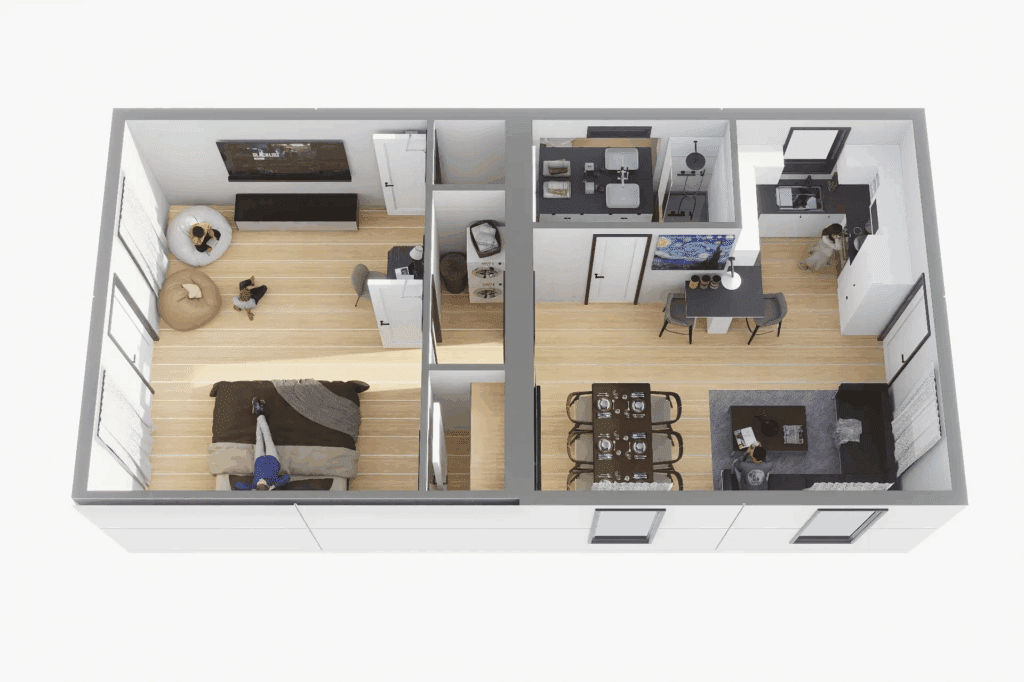
Boxabl began in 2017 with the audacious mission of making housing scalable, affordable, and simple. Its flagship product, the Casita, is a 361-square-foot studio home packed into a box that unfolds into a fully equipped living space. It comes with a kitchen, bathroom, HVAC, and appliances—ready for occupancy as soon as utility hookups are available.

The company’s defining innovation lies in its transport model. Each unit folds down to fit within the dimensions of a standard shipping load. That means fewer oversized deliveries, lower transport costs, and easier logistics compared to traditional modular construction. Once on site, the home can be unfolded and set up in less than an hour, eliminating many of the delays tied to on-site labor.

Beyond the single Casita, Boxabl envisions a system of stackable and connectable modules. These could be arranged to form multi-room homes, duplexes, townhouses, or even small apartment clusters. In essence, the company is not just selling a unit—it is selling a building system that can evolve with the needs of a homeowner or a city.

Regulatory progress has been uneven. While Boxabl has faced resistance in certain jurisdictions, it has achieved approvals in states including New Mexico and California. That’s significant because it means Boxabl’s product could more readily slide into municipal modular housing programs like the one Albuquerque is exploring.

On the financial front, Boxabl is positioning itself for rapid growth. The company announced in 2025 that it would go public via a $3.5 billion SPAC merger with FG Merger II Corp. This move, along with more than $230 million already raised, reflects the scale of its ambitions. Still, as with many disruptors, the road has not been smooth. Critics point to building code battles, zoning hurdles, and questions about whether the company can deliver on the hype at scale.

Albuquerque’s Modular Proposal: A Playground for Boxabl?

The proposal reported by KRQE suggests activating vacant lots throughout Albuquerque with modular housing. The plan emphasizes speed, affordability, and turning idle land into livable spaces.

The city’s Metropolitan Redevelopment Agency is working with the Piru Group on the proposal that would install a total of 42 modular housing units throughout vacant lots in the city. The group is calling these one-bedroom homes, ‘the future of housing.’

If Boxabl were to partner with the city, the potential impact could be dramatic. The company’s foldable units could reduce time-to-occupancy to a fraction of traditional construction. A home delivered in a box and unfolded on site could quickly provide relief in a city struggling with housing shortages.

Affordability is another advantage. By building in a controlled factory environment and cutting down transport and labor costs, Boxabl aims to make modular housing more cost-effective. This scalability could allow Albuquerque to roll out housing in increments, matching the pace of demand without requiring massive upfront investment.

Because Boxabl has already secured certification in New Mexico, regulatory approval may be less of a hurdle than for other modular providers. That could allow the city to move more quickly from concept to pilot program.

There are also design considerations. By stacking and connecting units, Boxabl offers flexibility beyond the single Casita. Albuquerque could experiment with different configurations—some resembling traditional neighborhoods, others creating denser urban clusters. The challenge will be integrating these modules into the existing urban fabric, ensuring that aesthetics, green space, and livability are not overlooked.

Finally, there’s the question of long-term durability. Factory-built homes often benefit from tighter quality control and predictable maintenance, but Boxabl’s unique folding design has not yet been proven at large scale over decades of use. Albuquerque would need to balance the immediate appeal of quick solutions with the responsibility of ensuring sustainable housing stock.

Beyond the Box: The Broader Implications

Boxabl’s model intersects with three major shifts in the construction world. First is the rise of factory-scale housing, which treats homes more like cars or electronics—products assembled in controlled conditions rather than crafted piece by piece on site. Second is transport-efficient modularity, where the folding design lowers logistical barriers that have long hampered modular expansion. Third is adaptable growth, where homes can expand by simply adding more modules, avoiding the waste and disruption of traditional additions or rebuilds.

These shifts are exciting, but they are not without friction. Building codes remain entrenched in traditional norms, often requiring extensive negotiation before a new modular system is approved. Even with factory-built efficiency, homes need roads, sewers, power lines, and inspections—site readiness can be a bigger bottleneck than the building itself. And while investors are flocking to Boxabl, there’s always the risk that hype gets ahead of delivery.

Yet, the urgency of the housing crisis means cities cannot afford to ignore bold approaches. With affordability slipping further out of reach for many families, with natural disasters displacing thousands, and with vacant land sitting unused in cities across the country, the need for solutions has never been greater. Boxabl is not a silver bullet, but it may be a crucial arrow in the quiver.

A Vision of Albuquerque’s Tomorrow, in Modules

Imagine walking through downtown Albuquerque a year from now. Three vacant lots that once sat empty now host compact neighborhoods of Boxabl Casitas. Some are stacked to create duplexes, others linked to form row-style homes. Shared courtyards give residents green space. Solar panels line rooftops. What once was a dead zone of urban land now pulses with life and community.

This vision is ambitious, but it is achievable if Albuquerque embraces modular innovation. By piloting a handful of Boxabl units, the city could become a national model for urban infill. If it succeeds, the experiment could inspire other municipalities to rethink how they use space, manage costs, and deliver housing at speed.

In an era where housing often feels like a locked box, Boxabl is daring to unfold the possibilities. And Albuquerque’s modular housing proposal might be the perfect place to test whether those possibilities can become reality.

Gen Z is Choosing Trade Schools Over College — And It Couldn’t Come at a Better Time

For decades, the story was the same: graduate high school, go to college, get a degree, land a career. But for many of today’s young people—especially Gen Z—that story doesn’t feel like the right fit anymore. Instead, they’re taking a serious look at trade schools, particularly in the MEP (mechanical, electrical, plumbing) and construction trades.

And here’s the kicker: it’s not just a fallback option. For many Gen Zs, it’s a first choice.

Let’s face it: automation and artificial intelligence are reshaping industries faster than most people realize. Tasks that are repetitive, data-driven, or “mundane” are being handed over to machines. In manufacturing, we’re already seeing AI-driven robotics assemble components. In construction, software is taking over project scheduling, estimating, and compliance checks.

But here’s the catch—no robot or AI system is ready to crawl into an attic to wire a house, or sweat copper pipes under a sink, or troubleshoot an HVAC unit in the middle of winter. Skilled trades are hands-on, problem-solving, human-centered work. Gen Z recognizes this. They see that these jobs are safe from replacement, and in many cases, they’re becoming more valuable as older generations retire out of the trades.

Something else is driving this shift: pride. Gen Z isn’t just chasing a paycheck; they want work that feels meaningful. After years of being told that coding or sitting behind a desk was the future, many are discovering that creating something with their hands is incredibly satisfying. Building a wall, wiring a panel, or fixing a system has instant feedback—you see and feel the results of your labor.

For a generation raised on screens, that kind of tactile accomplishment is a powerful motivator.

Trade schools are responding with fresh, fast-paced programs. Instead of four years of college and six figures of debt, many programs are structured as six-week to six-month certifications, often tied directly to internships or apprenticeships. Some schools even run accelerated bootcamps where students learn by doing from day one.

And here’s where it gets really interesting: many companies are stepping up to cover tuition fees, offer stipends during training, and guarantee positions once students complete their program. Imagine finishing school with zero debt, a job offer in hand, and a starting salary that often competes with or surpasses the income of recent college grads. That’s not a hard sell to an 18-year-old weighing their options.

The economics are clear. While the average college student graduates with more than $30,000 in debt, a trade school graduate can often walk out debt-free—or close to it—and into a job paying $50,000 to $70,000 to start. Add overtime, union benefits, or specialized certifications, and those numbers climb quickly.

Gen Z is also realistic about housing costs, inflation, and job stability. They’re doing the math and realizing that the trades don’t just make sense—they make dollars.

Here’s where offsite construction factories come in. These facilities are in the middle of their own transformation, adopting automation and AI to speed up processes while still relying heavily on skilled labor to actually build, assemble, and finish homes.

For offsite factories, the Gen Z trade school trend is a lifeline. It means a growing pool of young workers trained in carpentry, electrical, HVAC, and plumbing—all trades essential inside the factory walls. Unlike traditional construction, factories can offer steady, year-round work in a climate-controlled environment, something that appeals to Gen Z’s desire for stability and balance.

At the same time, offsite companies have a chance to shape this workforce by partnering directly with trade schools. Offering internships, sponsoring classes, and even embedding factory-specific modules into training programs can create a pipeline of job-ready talent. Imagine a trade school graduate who not only knows how to run conduit but also understands how their skills plug into an assembly line that produces homes at scale. That’s the kind of synergy this industry has been craving.

Offsite companies don’t have to sit on the sidelines. They can:

  • Sponsor scholarships or tuition reimbursement for students willing to work at the factory after graduation.
  • Offer tours and open houses to show trade school students what factory work looks like—fast, precise, and collaborative.
  • Develop apprenticeship programs where students split time between school and the factory floor.
  • Highlight career progression within factories, showing Gen Z that their skills can grow into supervisory and management roles, not just entry-level positions.

By investing in these partnerships, factories not only fill their labor pipeline but also elevate the reputation of offsite construction as a career destination, not just a job stop.

Offsite Innovators’ Bottom Line

Gen Z isn’t rejecting higher education altogether—they’re simply redefining what education means. For them, a welding certificate, an HVAC license, or a journeyman card carries as much value (if not more) than a bachelor’s degree. And they’re right. In an AI-driven future, the ability to fix, install, and build is as irreplaceable as it gets.

For offsite factories, this is the moment to double down. These young workers are eager, debt-free, and ready to put their hands and talent to work. With the right outreach, factories can not only benefit from the trend but help accelerate it.

High-paying jobs. No college debt. Skills that matter. And now, a factory-built future that Gen Z can be proud to help construct.

The Quoting Conundrum: Why Offsite Construction Pricing Is Still a Maze

Even after decades in this industry, I still find myself shaking my head at the quoting process most offsite factories use. Recently, my business partner and I were involved in trying to get three factories to quote on a project. It should’ve been simple: we handed over the same complete specs to each. What we got back was anything but clear — and that’s being polite.

One factory replied within a day, one took a week, and one landed somewhere in between. All three sent us quotes. Only one of them actually addressed the specifications we provided. The others seemed to rely almost entirely on their preloaded standard templates, with minimal effort to adapt them to our project.

It was like asking three bakers for a wedding cake and getting back one wedding cake, one birthday cake, and one loaf of bread with frosting on it.

Then came the real time drain: trying to compare them.

Apples, Oranges, and Mystery Meat

Hours upon hours went into lining up each quote side by side, translating vague line items and deciphering what was included, excluded, or just assumed. Freight? One included it. One didn’t. One bundled it under “miscellaneous.” Taxes? Same mess. Set and installation? Two mentioned it but only one priced it. And nobody seemed to define their post-production charges the same way.

The kicker? One quote came in almost 20% higher than the other two, and even after decades in this business, we couldn’t figure out why. If my partner and I can’t untangle this, how in the world is a developer or builder supposed to?

So what do they do? Most likely, they stick with the one factory they’ve worked with before—the one that at least confuses them the least. That might feel safe, but it can easily cost them money and flexibility down the road.

The Missing Link: Architects Who Don’t Speak “Factory”

Adding to the chaos is what I call the elephant in the room: the Architect. Most architects hired to design these projects have little to no knowledge of what the factory can actually produce. Their drawings often ignore the limits of the production line, leaving factories to either over-engineer the quote or omit critical pieces entirely. Both options lead to incomplete or misleading pricing.

This misalignment between design intent and manufacturing capability is one of the biggest reasons factory quotes come back as vague jigsaw puzzles instead of clear offers.

Why This Matters: Trust and Transparency

In an industry trying to win over developers, municipalities, and financiers, this is more than an annoyance—it’s a credibility problem. If factories can’t clearly show what they’re quoting, how can they expect anyone to trust their numbers?

Developers want to know two things:

  1. What am I getting?
  2. What will it cost me, soup to nuts?

Right now, too many quotes only answer half of those questions, and usually in fine print.

Fixing the System: Five Ideas

Here’s how the industry could start pulling itself out of this mess:

1. Create a Universal Quote Template
Imagine if every factory used a common framework that broke down every project into the same categories—structure, finishes, MEP systems, site setup, freight, taxes, and contingencies. Each factory could still plug in its own numbers, but at least the structure would be consistent.

2. Require Clear Inclusions and Exclusions
Quotes should have a mandatory section that spells out what is not included. If freight isn’t included, say it. If sales tax varies by state, note it. If installation is only “assisted set,” explain that.

3. Build Customer-Facing Configurators
Factories should invest in customer-friendly quoting software that pulls in their standard options but allows for project-specific specs. It shouldn’t take a trained engineer to figure out what a wall costs or whether it comes pre-wired.

4. Get the Architect and Factory Talking Early
Too many projects treat design and production as separate silos. Get the factory involved in the schematic design phase. Educate architects on modular design principles so their drawings are buildable and quote-friendly.

5. Add a “Quote Translator” Role
Some factories are starting to assign dedicated staff to review outgoing quotes for clarity and completeness. That simple quality-control step could save hours of confusion downstream and reduce the number of change orders later.

The Bottom Line

The offsite construction industry sells itself on speed, predictability, and cost control. But when a developer gets three wildly different quotes for the same project, that promise crumbles. If veterans like us struggle to decode them, newcomers don’t stand a chance.

If you continue having trouble understanding a factory quote for your project or home, Bill is here to help.

Bill Murray, experienced Advisor to the Offsite Construction Industry

 Sign up for a Free 30-minute Video talk about your company’s future options.

It’s Time to ReBuild It Better

Picture this.
You gather everyone in your offsite construction company—managers, drafters, production crews, even the guy who somehow always fixes the nail gun with chewing gum and a smile. The room is buzzing with quiet curiosity, waiting for the usual safety talk or production update.

Instead, you drop this bomb:

At first, they blink. Then it happens.

The Room Comes Alive

It starts with a few brave souls. Someone points out that the scheduling software causes more chaos than clarity. Another says the wall panel line was never set up for efficiency, just jammed into whatever space was left. A crew lead admits that training new hires is like tossing them in the deep end and hoping they float.

Suddenly, everyone’s talking. Not complaining—building.

Ideas fly. Frustrations finally see daylight. People who’ve quietly tolerated the daily grind are sketching out better ways to do it. You can almost feel the oxygen come back into the room.

For a moment, it’s electric.
And then… you say it.

Silence.
The air shifts from excited to nervous in a heartbeat.

Because now it’s real.

They picture their jobs changing—or disappearing. They picture production slowing down. They wonder who’s going to be blamed for the old way and who will be left standing when the dust clears.

And just like that, the enthusiasm that lit the room like a sparkler suddenly feels like a wildfire creeping toward their desks.

Change sounds exciting… until it sounds like risk.

Here’s where you find out what your company is really made of.

In a high-trust shop, your crew will lean in. They’ll want to help shape the future. They’ll volunteer to pilot new processes, rethink old habits, and prove that they’re part of the solution.

But in a low-trust shop, fear takes over. People retreat. They start quietly thinking about their résumés. Innovation dies in the same meeting where it was born.

You can’t bulldoze fear with enthusiasm. You have to build trust first, brick by brick.

Handled well, this moment can be a turning point. A company reborn from the inside out.

Handled poorly, it’s just another big speech no one believes, followed by a slow fade back to “the way we’ve always done it.”

The difference comes down to leadership.
Not the chest-thumping kind—the listening kind.
The kind that turns those raw, honest answers into an actual plan. A plan where employees lead the charge, not just watch from the sidelines waiting for the next round of chaos.

Asking “What would you change if we could start over?” can be the boldest, bravest question a factory owner ever asks.

But if you’re going to light that fuse, you’d better be ready to guide everyone through the explosion—and into something better on the other side.

Because this isn’t about tearing down a company.
It’s about finally giving everyone the chance to build it right.

If you believe it’s time for your factory to make some changes, Bill and I are here to help.

Bill Murray, experienced Advisor to the Offsite Construction Industry

 Sign up for a Free 30-minute Video talk about your company’s future options.

STOP, SMILE, and LISTEN

A Simple Habit That Can Change Your Entire Factory

Originally, I thought of writing this just for offsite factory owners and general managers, but as the words started to form, I realized something important: this message is for everyone. Everyone in an offsite construction factory. Everyone in any workplace, really. It’s about something so simple it almost sounds silly—and yet, it might just change your entire day.

It’s called: STOP, SMILE, and LISTEN.

Starting the Day on Empty

Imagine yourself as the owner or GM of an offsite construction factory. You’re building wall panels, components, or full modular homes. It’s 8:00 AM. You pull into your reserved parking space, walk through the front doors without making eye contact with anyone, and head straight to your office. You sit at your desk, take a deep breath, and wonder who or what is going to f**k up your day.

Sound familiar? That’s how far too many people start their morning—closed off, braced for the worst, and already wearing their frustration like armor. It’s not malicious. It’s just habit. But it’s also contagious.

Seeing What’s Already Going Right

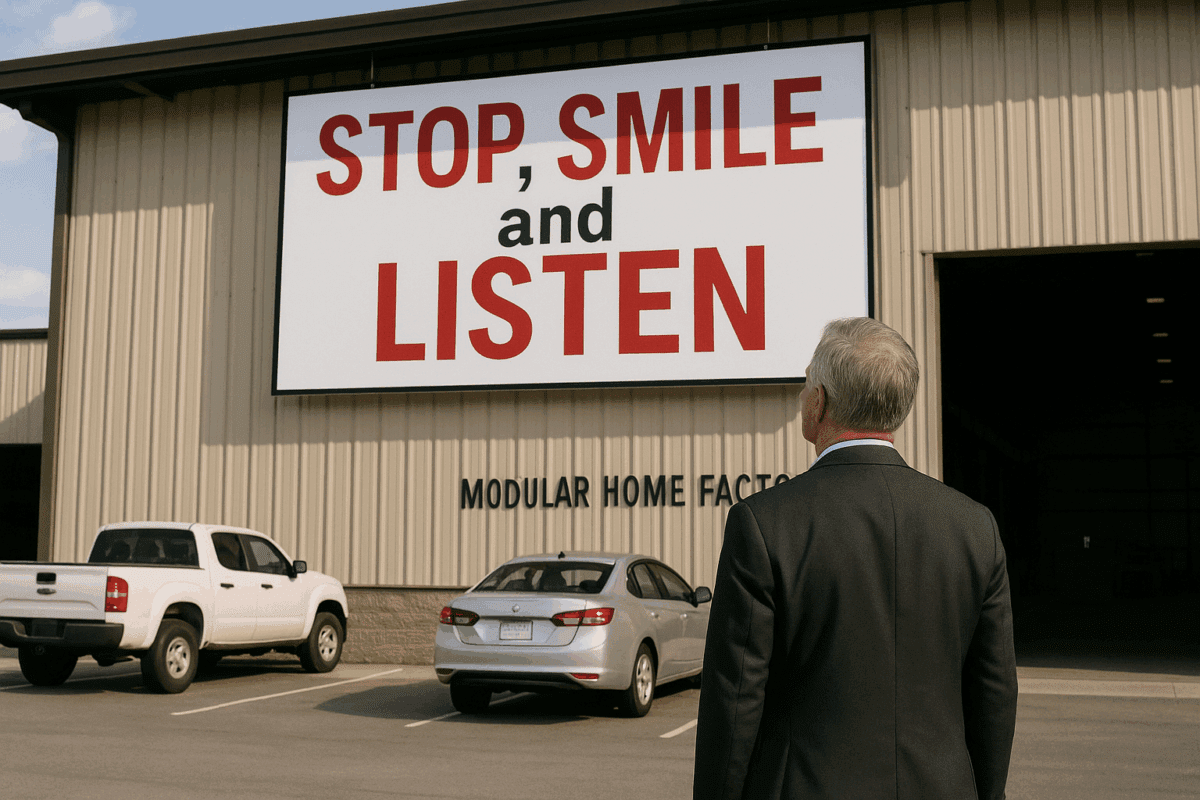
Now let’s imagine something different. As you pull into that parking space, picture a big sign bolted to the wall in front of you: STOP, SMILE, and LISTEN.

So you stop. You look around. The production line is humming, your employees are already inside working, and trailers are lined up outside with modules ready to ship—real homes that someone chose to buy from your company. In the visitor parking area, you spot a couple of unfamiliar cars. Someone is here, right now, hoping to do business with your company.

That’s amazing, isn’t it? You just saw it—and appreciated it—instead of walking past it.

Creating Small Sparks of Connection

You step through the front door and are greeted by your receptionist. Normally you’d nod and keep walking, but today you stop.

“How are you doing this morning?” you ask.

“OK,” they answer, which these days can mean anything from “fine” to “hanging on by a thread.”

This is where you deliver your first SMILE of the day. “Just OK? It’s a beautiful morning out there.”

And suddenly, something shifts. They either agree and smile back, or maybe they open up about something personal—a sick child who’s finally better, a great dinner they had last night, or just the relief of finishing a tough week.

And you listen.

That simple, sincere moment has power. The person who greets everyone who walks in the door is now carrying a little spark of warmth, and they’ll pass it along to the next person who comes through. You don’t have to do it every day, but do it enough, and it becomes part of the air your team breathes.

Making It a Daily Practice

Keep doing this. Ask the receptionist who the visitors are meeting with. If someone new is talking with your corporate buyer, knock on the door, step in, shake their hand, and say, “Welcome to our factory.” Then walk out. That’s it. It’s not your job to buy things, but it is your job to build relationships.

A couple of times a week, stroll the production line. Stop for thirty seconds next to someone doing a great job or trying something new. Smile. Listen. Let them know you see them. Do the same with a salesperson you bump into in the hallway. These aren’t interruptions; they’re investments.

Why It Changes Everything

Before long, this practice rewires your mornings. The dread of “what’s going to go wrong today” gets replaced by “look at what’s already going right.” Negativity loses its grip.

Even better, you’ll start to really know the people who’ve chosen to work for you—their names, their stories, their talents. You’ll see them as more than job titles or productivity stats, and they’ll see you as more than a signature at the bottom of a paycheck.

And that is how workplaces transform—not with a grand announcement, but with one small decision made every day: STOP, SMILE, and LISTEN.