Highlighting the thinkers and their ideas driving the evolution of Offsite Construction. 
Be inspired, be informed, be innovative!

The Three Conversations Every Modular Owner Is Afraid to Have — But Must

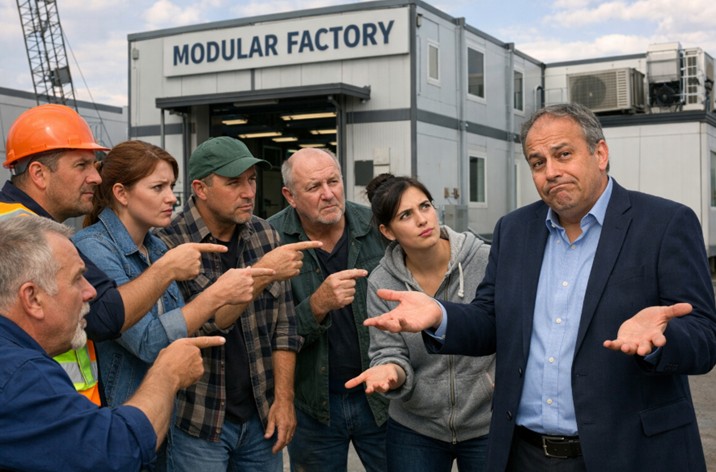
If you own a modular factory, you’re basically running a small city—except nobody listens, everything costs more than you expected, and the weather is never on your side. Most days you deal with a perfect storm of backorders, missing trim, angry developers, and one employee who always calls out on payday.

But the part factory owners dread the most?
Not OSHA.
Not drywall cracks.
Not even punch-list season.

Not the easy ones about paint colors or forklift upgrades.
I mean the real conversations—the ones everybody avoids until it’s either too late or too expensive to ignore.

After 20+ years in this industry, visiting factories big and small, family-run and VC-funded, I’ve discovered three conversations that every modular owner knows they need to have… yet hopes the universe will handle for them.

It won’t.
So let’s spell them out.

There is no word harder for a modular factory to say than no, especially when a developer is dangling a “100-unit project” like a shiny fishing lure. Developers are charming. They’re confident. Their PowerPoints sparkle. Their schedules are “aggressive but doable.” Their financing is “99% locked in.” Their drawings are “almost final except for a few details.”

And we fall for it—every time.

Factory owners nod politely, take the binder, promise to review it, and then lie awake at night wondering why the roof plan has four different pitches and no mechanical layout.

Here’s the truth nobody wants to say:
Most bad modular projects go bad on the front porch, not the factory floor.

That first conversation should sound like this:

“Your timeline won’t work, your drawings are missing important details, your financing needs more proof than a handshake, and we are not gambling the factory just because you’re excited.”

But owners rarely say that. We say things like:
“We’ll take a closer look.”

Translated: “We haven’t learned our lesson yet.”

Saying no isn’t just self-protection. It’s a competitive advantage.
Good developers respect boundaries.
Bad developers disappear.

Either outcome is a win.

This one is a little delicate.

General Managers are the heroic duct tape of modular factories. They fix everything, know everyone, and can tell you instantly which employee is about to quit. Many rose through the ranks, starting as carpenters or set crew warriors. These folks know the business the way a farmer knows his crops.

But the industry has changed faster than some GMs have.

Automation. AI scheduling. Digital twins. Lean manufacturing.
It’s not 2005 anymore, even though some factories still run like it is.

Every factory eventually needs to have the conversation:

“Look, we love you. You’ve been amazing. But if we’re going to survive the next five years, we need new systems, tighter processes, and a willingness to change. Can you lead that? Because if not… we need to bring someone in who can.”

That conversation terrifies owners because it feels personal—and because it might trigger the dreaded GM pout, which causes production delays of its own.

But here’s the hard fact:
A factory can outgrow a GM long before anyone says it out loud.

The best GMs adapt.
The worst ones blame labor, suppliers, and the moon’s gravitational pull.

If your factory’s biggest bottleneck has an office, a desk, and your old photo on the wall, it’s time for this conversation.

Modular factories love volume. Big backlogs. Big shipments. Big headlines.

But here’s a secret few want to admit:

You can’t make up for unprofitable processes with more volume.
You only go broke faster.

Every factory has one or two skeletons in the profitability closet:

  • A product line that hasn’t made money since flip phones
  • A developer who gets “special pricing” nobody can explain
  • A process so outdated that even OSHA says, “Really?”
  • A service department that loses $300 on every callback

This conversation sounds like:

“We’re cutting this product line.”
“We’re raising prices.”
“We’re redesigning the workflow.”
“We’re letting go of that client.”

And the reaction is always the same:
“Are you sure? They bring us a lot of volume.”

Yes. They bring volume the way thunderstorms bring water—plenty of it, but it floods your basement.

Factories that survive long-term are brutally honest about what makes money and what doesn’t. They don’t prop up zombie products or zombie clients because “it would be awkward to change now.”

Awkward is fine.
Bankruptcy is worse.

Because modular construction is personal.
It’s emotional.
Every decision touches people.
And owners are human—they want harmony on the floor, peace in the office, and a backlog that doesn’t look like a pending disaster.

But avoiding these conversations is like ignoring a leak in the roof:
It doesn’t stay small.
It spreads, rots, and multiplies.

The industry is full of examples where silence costs more than speaking up:

  • Failed projects that should’ve been declined
  • GMs who stayed five years too long
  • Money-losing product lines protected by nostalgia
  • Developers who drained factories dry
  • Owners who realized the truth only after the lender pointed it out

Silence is expensive.
Delay is costly.
Avoidance is deadly.

But the surprising silver lining is this:

Once an owner finally has these conversations, the factory gets better immediately.
Lighter.
Clearer.
More focused.
More profitable.

Modular factories don’t crumble from one big mistake.
They crumble from a thousand small conversations that never happened.

So have them.
Say the uncomfortable thing.
Protect your factory.
And sleep better knowing you steered the ship instead of hoping the tide would fix itself.

Your employees will thank you.
Your balance sheet will thank you.
And one day, your banker might even smile at you again.

If you’d like to explore this further, connect with Bill today.

Bill Murray, Co-Founder of Offsite Innovators

What My Father Taught Me About the Offsite Industry

My father was a man of simple wisdom, the kind of person who could solve a business problem with a cup of coffee and a sentence that didn’t appear in any MBA textbook. Some fathers quote Churchill or Sun Tzu. Mine quoted wildlife.

He’d look at me over the dinner table, usually while slicing his meatloaf with the precision of a surgeon, and say:

“Rabbits and squirrels will always be prey.”

Now, when you’re twelve years old, this sounds less like business advice and more like the opening line of a National Geographic documentary. But as the years passed — and as I spent decades watching modular factories rise, fall, reopen, rebrand, collapse again, and blame it on the weather — his line started to make perfect sense.

And eventually I realized he wasn’t talking about animals.

He was talking about factory owners, developers, general managers, and sales reps.

Which honestly explains a lot.

So, in honor of my father — and the entire offsite construction ecosystem that behaves exactly like a forest filled with caffeine-addicted woodland creatures — here is your field guide to survival.

Bring binoculars.

Ah yes, the rabbits — the most common species in the offsite forest. They hop into the industry full of optimism and high speed, certain they’ll revolutionize everything with their innovative floor plan, their “unique” marketing phrase, or their belief that builders love paying more for modules if you just explain it slowly.

Rabbits:

  • sign contracts before calculating costs
  • quote projects during full moons
  • panic whenever interest rates move
  • adopt new software every 90 days
  • make major decisions before breakfast

They don’t build reserves. They don’t build systems. They don’t build predictable quoting. They build excitement.

Rabbits are the folks who say, “We’re going to triple production this year” and then six months later whisper, “We’re taking a little break while we reorganize.”

Rabbits don’t die because the market kills them.
Rabbits die because they trip over their own enthusiasm.

I’ve met hundreds of them. I’ve eaten donuts in their conference rooms. They bounce around like they’re powered by solar panels and anxiety. They move fast but have no idea where they’re going.

Cute? Absolutely.
Predators? Not a chance.
Snack-sized? Definitely
.

Squirrels are more cautious than rabbits. They hide their acorns, protect their acorns, inventory their acorns, count their acorns every quarter, and then discuss at the annual meeting whether they might buy one more acorn if the economy stabilizes.

A squirrel factory:

  • hasn’t raised its base price since 2008
  • still uses the same employee handbook from 2005
  • thinks automation is “too risky”
  • believes growth is suspicious
  • views innovation the way a squirrel views a German Shepherd

Squirrels survive, but only because no one can find them long enough to kill them. They’ve mastered the art of being in business without standing out in business.

Squirrels attend conferences but sit in the back.
Squirrels listen to presentations about AI and robotics and mutter, “Not for us.”
Squirrels store cash but never deploy it.

They are competent. They are safe. They are consistent.

And Squirrels will absolutely be prey forever.

Now we’re finally getting somewhere.

Hawks are rare — which is why they thrive. They don’t try to build everything. They don’t chase every customer. They don’t reorganize their production line every Tuesday after watching a YouTube video about Toyota.

Hawks know who they are.

Maybe they’re the townhouse specialist.
Maybe they’re the ADU whisperer.
Maybe they’re the school-building savant.
Maybe they’ve mastered the art of building 14 different versions of the same 28×48 ranch without losing their mind.

Hawks fly higher than rabbits, meaning they can see trouble coming. They can also see opportunity forming before anyone else hears a rustle in the bushes.

Hawks do not panic.
Hawks do not hoard.
Hawks do not chase.

Hawks hunt.

Which means they are the natural predator of rabbits, squirrels, and — occasionally — undercapitalized bears.

If hawks are the specialists, wolves are the professional operators.

A wolf company doesn’t operate on hope, caffeine, or whatever inspirational quote was circulating on LinkedIn that week. Wolves operate on:

  • systems
  • training
  • leadership
  • process control
  • actual job costing
  • schedulers who enjoy color-coded spreadsheets

A wolf is a GM who knows exactly where every project stands, and when he doesn’t know, he actually asks — instead of hiding in his office until the crisis magically resolves itself.

I have walked into wolf factories. You can tell immediately.

No yelling.
No chaos.
No fires to put out.
No “Hank didn’t show up again, so we’re short.”

Wolves move in packs.
Sales, production, engineering, accounting, and leadership all move in the same direction.
You never see one wolf sprinting ahead while the rest claw at the ground trying to catch up.

The wolves are the ones who will quietly buy a struggling rabbit factory, keep the best employees, close the side door that’s been open since 2011, and turn the whole thing into a functional operation inside six months.

Wolves don’t brag.
They don’t make noise.
They don’t post in ALL CAPS on LinkedIn.

Wolves simply dominate.

Every few years, a massive new bear wanders into the modular forest wearing a hard hat, carrying a billion dollars, and announcing that they’re going to disrupt the entire industry by doing exactly what the industry has always done — but louder. Think Katerra, L&G, and Entekra.

Bears are impressive.
They attract headlines.
They attract investors.
They attract half the construction journalists on earth.

The problem is that bears also attract gravity.

And gravity has taken down more giant modular startups than any hawk or wolf ever has.

A bear can do enormous good.
A bear can also collapse in a spectacular pile of debt, ambition, and unused robotics.

The tricky part is that when a bear falls, it falls on everyone.

But that’s nature.
The woodland creatures scatter, and the survivors carry on with slightly more skepticism than before.

My father didn’t say his line as a threat. He said it as a reminder:

If you behave like prey, you will live like prey.
If you behave like a predator, you will survive.

And that’s the offsite industry in a nutshell.

Some factories run like twitchy rabbits.
Some operate like nervous, hoarding squirrels.
Some soar like hawks.
Some coordinate like wolves.
Some lumber in like bears who haven’t read the instruction manual.

And somehow, all of them show up at industry conferences, sit at round tables, and nod politely while speakers talk about “transformation,” “innovation,” and “scaling responsibly.”

I sometimes wish a hawk, a squirrel, and a wolf would all sit on a panel and just explain their business models in wildlife terms. It might be the most honest session we’d ever have.

After all these years, I can still hear my father’s voice whenever I talk to a factory, walk a production line, or get pulled into another discussion about why a startup needs $38 million before building its first prototype.

He’d say:

“Rabbits and squirrels will always be prey.”

He was right then.
He’s right now.
And if I had to guess, he’ll be right long after AI is managing factories, drones are delivering modules, and wolves are still shaking their heads at the rabbits who never learned.

The forest doesn’t lie. It just teaches.

Confessions Over Coffee: Two Factory Friends Discuss the Useless Conference Circuit

I recently had lunch with a retired GM from one of the big modular factories—the kind that had more powernailers than employees and still called it progress. We met to catch up on life after his retirement, that sweet chapter where you finally stop pretending to care about production schedules.

He knew what I was up to—blogging my way into offsite industry infamy—so I asked what he’d been doing. With a twinkle in his eye, he confessed that after four years away, he missed it all so much he started attending small industry conferences… not to learn, mind you, but “so people don’t forget my name.”

It’s hard to argue with that. Nostalgia’s cheaper than therapy.

We both agreed that, in theory, these gatherings are supposed to be the beating heart of the offsite and modular industry—grand platforms where professionals network, share knowledge, and discover new opportunities.

But somewhere between the third panel discussion and the fifth coffee refill, that noble mission dies quietly—smothered by buzzwords, vague insights, and PowerPoint slides that look suspiciously like last year’s.

Is it our age, we wondered (ha!), or has the content at these conferences become so flavorless it dissolves in memory before you even check out of the hotel? I’d say it’s a bit of both. Once upon a time, the sessions had substance. Now, you can learn more from a LinkedIn scroll or a late-night Google rabbit hole than from any keynote speaker with “synergy” in their title.

The networking, however, remains pure gold. It’s the one part that still feels real. You can’t beat bumping into people who speak your language—“lead time,” “backlog,” “code approval”—and seeing the look of exhaustion that says, Yes, my factory’s on fire too.

photo – BuilderTrend

There’s comfort in that shared misery, the kind you just can’t get through a Zoom screen. The handshakes, the laughs, the whispered gossip about who’s expanding and who’s imploding—worth every penny of the overpriced conference badge.

And then comes the part that’s supposed to make it all worthwhile: discovering new opportunities.

I don’t know what conferences the marketing teams are attending, but at the ones I go to, “new opportunities” usually means getting cornered by a tech startup selling factory management software that promises to “revolutionize” your production line—if only you’d give them your email.

It’s been years since I’ve seen something truly original on a conference stage. Most of what’s presented could be found in a three-minute Google search or, better yet, overheard at the hotel bar from someone who actually works in the field.

By the end of our two-hour lunch, we came to the same conclusion: conferences are, in essence, gloriously useless—but they beat sitting at home yelling at the media.

Pay your hundreds (or thousands) of dollars. Book the hotel room with decent Wi-Fi and questionable carpet. Sit through the sessions politely, collect the swag bag, and when you get home—forget every word that came from the stage.

Just remember the people you met. They’re the only part that matters.

Keep your eye on Offsite Innovators for news about an entirely different type of conference coming in early 2026. It will be worth every modest penny spent…

When the Offsite Factory Ends and Reality Begins: Why Costs Keep Slipping Away

A few weeks ago, an investor-developer called me after reading one of my articles about “New to Modular” builders. He was frustrated—actually, exasperated might be a better word. He had decided to try modular construction for a housing project and couldn’t understand why the cost between the factory and the finished, move-in-ready home was so unpredictable.

As he put it, “It’s like pulling teeth to get an answer. Everyone tells me modular is more efficient, faster, and less expensive, but the numbers keep slipping away the closer I get to the finish line.”

The Gap Between Factory and Front Door

His frustration highlights one of modular construction’s greatest communication failures: the gap between the factory gate and the final occupancy permit. Inside the factory, everything seems measurable. Costs are itemized. Production schedules are tracked. Materials and labor are controlled.

But once those modules are loaded onto a truck, the process becomes fragmented. Site work, foundations, transportation, set crews, mechanical hookups, finish work, landscaping, permits—it’s a long list of moving parts, often involving people who have never worked together before.

For a newcomer to modular construction, that’s where confusion sets in. The “factory price” often covers only what’s built inside the plant, while everything outside those walls is considered “site scope.” If the builder, developer, or GC hasn’t coordinated both sides of that equation, the result is a project where costs and schedules unravel.

Why the Final Cost Is So Elusive

There are three main reasons why that “finished cost” seems to keep moving:

1. Undefined Responsibilities. Factories typically sell what they build. They don’t pour foundations, handle zoning issues, or coordinate site crews unless they offer turn-key solutions. Developers often assume the factory will “manage” these steps—but that’s rarely included unless it’s spelled out in writing.

2. Subcontractor Chaos. Our investor hit the nail on the head: most subcontractors will offer either a good price or a good timeline, but rarely both. Many have limited experience finishing modular projects and don’t realize how much coordination is required to align with delivery and set schedules.

3. The Unknowns Between Delivery and Occupancy. Weather delays, transportation permits, crane availability, and inspection timelines all play roles. Even small holdups—like missing trim pieces or incorrect site measurements—can snowball into weeks of delay, turning cost estimates into educated guesses.

The Investor’s Expectation vs. the Industry’s Reality

The caller made one more point that deserves attention: he believes modular factories should take on more of the process. And honestly, he’s not entirely wrong.

For modular construction to expand its market share, factories need to evolve beyond “box builders” into integrated solution providers. That doesn’t necessarily mean they have to become full developers, but offering more design, logistics, and finish coordination could bridge the trust gap that new investors experience.

This is exactly what some successful modular firms have already done. They act as designer, contractor, and manufacturer under one umbrella, eliminating the costly communication breakdowns that plague traditional modular projects.

What Needs to Change

If the modular industry wants to continue attracting serious investors and developers, three changes are essential:

  • Transparency: Factories must clearly define what’s included—and excluded—in their base price. A “factory-to-finish” roadmap should be standard.
  • Integration: Developers and factories must work as partners from the start, not as separate entities meeting halfway through.
  • Education: The industry needs to train new-to-modular builders and investors in how the process really works, not just how it looks on a glossy brochure.

My Final Thoughts

The investor’s experience is not unusual—it’s a rite of passage for anyone entering modular construction for the first time. He didn’t want a free consultation; he wanted reassurance that the system works. But until factories, developers, and site crews operate as a unified team, that reassurance will remain as elusive as a locked-in cost.

In modular construction, the real work begins not in the factory—but the moment the first module rolls out of it.

Where Profit Really Slips Away: The Hidden Moments That Decide a Factory’s Fate

In modular and offsite construction, profit isn’t made when the last module leaves the factory—it’s made (or lost) in the hundreds of smaller moments that happen long before that. Most factory owners know their gross margin target, but few can tell you precisely when and where that margin starts to slip off the table.

It Starts Long Before the Floor

Walk into any offsite construction factory and you’ll see order, efficiency, and the hum of production. But the story of profit doesn’t begin there. It begins weeks or even months earlier in the estimating and quoting process, where a single optimistic assumption can plant the seed for future losses.

Many estimators still rely on outdated spreadsheets or supplier pricing from three months ago. They assume consistent labor productivity or fail to add contingency for one-off designs. Then, when the project is awarded, everyone breathes a sigh of relief—until the first purchase order shows materials that cost 8% more than quoted.

It’s not the factory floor that breaks the budget. It’s the estimate that was never stress-tested against reality.

Benchmark Moment #1: Compare your original labor and material estimates against actuals after the first two weeks of production. If you’re already running more than 5% off in either category, you’ve just seen your profit margin’s first crack.

Contracts Without Protection

In today’s volatile material market, locking into a fixed-price contract without an escalation clause is like walking a tightrope without a net. One shift in steel or lumber prices, or even a change in freight costs, and the project moves from black to red ink overnight.

Some factories still sign long-term projects without including an escalation clause or shared-risk adjustment for major materials. That may keep a client happy in the short term, but it leaves the factory absorbing all the market risk.

Factories that have learned this lesson the hard way now add a line or two that protects them—either tying prices to an index or stipulating a review if material costs rise beyond a threshold.

Benchmark Moment #2: Track project launch dates versus original quote dates. If production starts more than 90 days after the quote, review every cost line item again. Inflation waits for no one.

Design: The Quiet Profit Thief

Between the quote and the factory floor lies another trap—the design-to-production handoff. This is where even the most profitable-looking project can unravel.

Every time a design team issues a new drawing after release to production, it costs money. A missing framing detail, a late electrical layout, or a window specification change may look minor, but when it hits five modules on the line, it means downtime, confusion, and rework.

Factories that promote “design for manufacturability” have learned that profit protection starts with a disciplined pre-production process. One manager told me, “Every revision is a dollar sign. The fewer changes, the higher the profit.”

Benchmark Moment #3: Track the number of design changes after release to production. More than two changes per module type is a flashing red light.

The Floor: Efficiency vs. Throughput

Once a project hits the production line, the profit equation becomes a race between speed and waste.

The temptation is to judge success by output: “We shipped four modules today.” But throughput without efficiency is deceptive. If those modules took overtime hours, excessive material movement, or required rework at the finish line, the factory may have shipped its profit right along with them.

What separates strong factories from struggling ones is real-time visibility. When management knows daily takt time per station, total labor hours per module, and scrap percentage, they can spot small deviations before they turn into margin erosion.

Factories that rely on weekly or monthly summaries discover the truth far too late. By then, the money is gone.

Benchmark Moment #4: Review overtime hours as a percentage of total labor. Anything over 10% should trigger a meeting. It’s not just a payroll problem—it’s a process problem.

Supply Chain Slipups

The next profit leak often comes from the supply chain. A late delivery of insulation or an incomplete cabinet order can halt an entire line. When that happens, crews still clock in, but production stops.

Every hour of idle time is unrecoverable. Yet many factories don’t categorize downtime in a way that exposes its real cost. They track “line delay” but not why—and without the why, you can’t prevent the next one.

Progressive factories now use dashboards that tag every downtime minute by cause: missing materials, design issues, equipment failure, or labor shortages. Within a month, patterns emerge. That’s when management can start plugging the holes instead of guessing where they are.

Benchmark Moment #5: Track downtime cost per module. If unplanned downtime exceeds 3% of total project labor, you’re losing profit faster than you realize.

The Late-Stage Surprise

By the time the accounting department raises the alarm, the problem has already spread through multiple departments. The project’s done, but the margin is gone. It’s at this stage many factories say, “We’ll learn from this next time,” but rarely build systems to catch it earlier.

Profit protection requires an early-warning culture. That means supervisors, estimators, and managers must all have visibility into live data—not just production stats, but real financial impact.

When everyone understands how a missed delivery, an extra day on the line, or an underbilled change order affects profit, accountability becomes collective rather than reactive.

Benchmark Moment #6: Hold weekly 20-minute “Profit Pulse” meetings with estimating, production, and accounting. Review current variances and adjust before it’s too late.

Profit Awareness Is a Mindset

Here’s the uncomfortable truth: many factories aren’t losing money because they’re inefficient—they’re losing it because they’re unaware.
They have the data, but it’s trapped in different systems: estimating software, accounting programs, or spreadsheets no one updates.

A profitable factory doesn’t just measure output; it measures awareness. When every manager can see in real time whether they’re ahead or behind the margin curve, behavior changes. Suddenly, that extra 20 minutes of overtime matters. The missing pallet of drywall matters. The vague design note matters.

Profit protection stops being a finance department function and becomes a shared responsibility—just as it should be.

Catching It Early

When I ask general managers when they realized a project would lose money, I usually hear, “Near the end.” By then, it’s too late to fix. But if that same manager had seen a live variance report two weeks in—when labor ran 15% over target or material waste jumped by $600 per module—they could have intervened before the slide became a plunge.

Factories that catch problems early don’t do it with magic—they do it with systems. Dashboards, variance tracking, and tight coordination between estimating, production, and accounting are their lifelines.

When the warning lights flash, they act immediately. Not next month. Not when the project closes. Right now.

The Real Benchmark

Ultimately, the most important benchmark isn’t financial—it’s cultural.
Does your team care enough to ask, “Where’s our margin today?”
If they do, you’ve built a factory that understands that profit is a process, not a number.

Because in offsite construction, the moment someone says, “We’ll figure that out later,” that’s the exact moment profit starts walking out the door.

My Final Thought:
Profit doesn’t vanish in one bad decision—it slips away quietly, one overlooked estimate, one untracked hour, one missing clause at a time. The factories that survive and thrive are those that listen for those whispers early enough to act on them.

Because by the time you can see the problem clearly… it’s already costing you money.

If you’d like to explore this further, connect with us today.

My Modular Factory Music Playlist of Problems

Every offsite and modular construction factory has its own soundtrack—though it’s not always the one you want to hear. The clanging nail guns, the hum of saws, and the steady rhythm of forklifts backing up all make for an industrial symphony. But if you listen closer, you can almost hear songs that fit each major factory problem perfectly.

So, I made a playlist—five songs from my era, about 15 minutes total—that sum up the highs, lows, and daily chaos of modular construction life.

Problem: Constant production delays

Every factory hits a slump. Maybe the next module’s missing windows, the truss supplier’s behind, or the line’s been stopped since Tuesday because the forklift battery died. Whatever the reason, this anthem captures the one thing every modular team needs—unshakable optimism.
When you’re staring at a whiteboard full of red deadlines, crank this up and remind yourself: success in offsite isn’t a sprint; it’s a slow dance with logistics.

Problem: Design-engineering miscommunication

Ever had a BIM file that didn’t match the factory’s build sheet? Or a bathroom pod that somehow ended up one inch too wide for the truck? Zeppelin nailed that chaos in two and a half minutes. It’s the perfect soundtrack for the moment a factory supervisor yells, “That’s not what the architect drew!”
Pure, beautiful mayhem—and the anthem of every engineer who’s ever had to issue a “revision B” in record time.

Problem: Cash-flow crunch

Payroll’s due Friday. Your next draw hasn’t cleared. You’ve got 18 homes in production and 3 stuck in inspection limbo. Cue the pounding piano and frantic lyrics. Every modular startup founder has lived this song at least once.
“Money don’t get everything, it’s true…” Yeah, except material shipments, factory leases, and payroll. In our world, it’s always about timing the cash to match the chaos.

Problem: Factory morale and burnout

This one’s for the production floor—the men and women who swing hammers, cut panels, and keep the modules moving no matter how hot, cold, or complicated the day gets. The long solo is the perfect metaphor for that endless rhythm of work and pride.

When morale dips or someone says, “This job’s too hard,” play this loud enough to shake the siding rack. You’ll see a few heads nodding. Every modular worker is the working man.

Problem: Over-hyped innovation that fails in the field

Every few months, another “game-changing” modular startup appears—promising to disrupt the industry. And just as quickly, another one quietly folds.
Queen’s bass line is the sound of reality catching up. The startups that survive aren’t the flashiest or the loudest; they’re the ones that learn from every missed nail and cracked panel.
“Out of the doorway the bullets rip…” Yep—sometimes that’s just investor feedback.

The Encore: Why It Matters

Music is emotion, and modular construction has plenty of it. Every factory owner, plant manager, or builder could probably add their own verse to this playlist. The point isn’t just to laugh—it’s to remember that these challenges are universal. The key is to keep your rhythm, stay on tempo, and never stop believing (literally).

So next time your schedule slips, your drawings clash, or your budget gasps for air—turn on this playlist. Because sometimes, the only way to stay sane in modular construction is to sing your way through it.

The Quoting Conundrum: Why Offsite Construction Pricing Is Still a Maze

Even after decades in this industry, I still find myself shaking my head at the quoting process most offsite factories use. Recently, my business partner and I were involved in trying to get three factories to quote on a project. It should’ve been simple: we handed over the same complete specs to each. What we got back was anything but clear — and that’s being polite.

One factory replied within a day, one took a week, and one landed somewhere in between. All three sent us quotes. Only one of them actually addressed the specifications we provided. The others seemed to rely almost entirely on their preloaded standard templates, with minimal effort to adapt them to our project.

It was like asking three bakers for a wedding cake and getting back one wedding cake, one birthday cake, and one loaf of bread with frosting on it.

Then came the real time drain: trying to compare them.

Apples, Oranges, and Mystery Meat

Hours upon hours went into lining up each quote side by side, translating vague line items and deciphering what was included, excluded, or just assumed. Freight? One included it. One didn’t. One bundled it under “miscellaneous.” Taxes? Same mess. Set and installation? Two mentioned it but only one priced it. And nobody seemed to define their post-production charges the same way.

The kicker? One quote came in almost 20% higher than the other two, and even after decades in this business, we couldn’t figure out why. If my partner and I can’t untangle this, how in the world is a developer or builder supposed to?

So what do they do? Most likely, they stick with the one factory they’ve worked with before—the one that at least confuses them the least. That might feel safe, but it can easily cost them money and flexibility down the road.

The Missing Link: Architects Who Don’t Speak “Factory”

Adding to the chaos is what I call the elephant in the room: the Architect. Most architects hired to design these projects have little to no knowledge of what the factory can actually produce. Their drawings often ignore the limits of the production line, leaving factories to either over-engineer the quote or omit critical pieces entirely. Both options lead to incomplete or misleading pricing.

This misalignment between design intent and manufacturing capability is one of the biggest reasons factory quotes come back as vague jigsaw puzzles instead of clear offers.

Why This Matters: Trust and Transparency

In an industry trying to win over developers, municipalities, and financiers, this is more than an annoyance—it’s a credibility problem. If factories can’t clearly show what they’re quoting, how can they expect anyone to trust their numbers?

Developers want to know two things:

  1. What am I getting?
  2. What will it cost me, soup to nuts?

Right now, too many quotes only answer half of those questions, and usually in fine print.

Fixing the System: Five Ideas

Here’s how the industry could start pulling itself out of this mess:

1. Create a Universal Quote Template
Imagine if every factory used a common framework that broke down every project into the same categories—structure, finishes, MEP systems, site setup, freight, taxes, and contingencies. Each factory could still plug in its own numbers, but at least the structure would be consistent.

2. Require Clear Inclusions and Exclusions
Quotes should have a mandatory section that spells out what is not included. If freight isn’t included, say it. If sales tax varies by state, note it. If installation is only “assisted set,” explain that.

3. Build Customer-Facing Configurators
Factories should invest in customer-friendly quoting software that pulls in their standard options but allows for project-specific specs. It shouldn’t take a trained engineer to figure out what a wall costs or whether it comes pre-wired.

4. Get the Architect and Factory Talking Early
Too many projects treat design and production as separate silos. Get the factory involved in the schematic design phase. Educate architects on modular design principles so their drawings are buildable and quote-friendly.

5. Add a “Quote Translator” Role
Some factories are starting to assign dedicated staff to review outgoing quotes for clarity and completeness. That simple quality-control step could save hours of confusion downstream and reduce the number of change orders later.

The Bottom Line

The offsite construction industry sells itself on speed, predictability, and cost control. But when a developer gets three wildly different quotes for the same project, that promise crumbles. If veterans like us struggle to decode them, newcomers don’t stand a chance.

If you continue having trouble understanding a factory quote for your project or home, Bill is here to help.

Bill Murray, experienced Advisor to the Offsite Construction Industry

 Sign up for a Free 30-minute Video talk about your company’s future options.

17 Hilarious Reasons Offsite Factory Owners and Managers Refuse to Listen to Consultants

Every week, someone reaches out to Bill and I with a question that starts like this: “We’re having trouble with production delays, change orders, waste, low sales, high turnover, inspection issues, vendor complaints, cash flow, software, robots, wild deer in the breakroom…”

And then comes the kicker: “Do you guys charge for advice?” (Yes. Yes, we do. But clearly, that’s not the real issue.)

Because when we do give advice—when it’s paid, free, scribbled on a napkin, or wrapped in a LinkedIn article—they nod politely, thank us, and then go do the exact opposite.

So here it is: 17 brutally honest (and ridiculous) reasons offsite factory management won’t listen to consultants:

1. “Because we had a meeting in 2009 that said we’d never need consultants.” That 90-minute PowerPoint still rules the boardroom like a sacred scroll.

2. “Our problems are unique, and no outsider could possibly understand them.” Yes, you’re the only factory with employees, delays, and 6,000 unfiled change orders. Clearly.

3. “We like to learn things the hard way. It’s tradition.” Similar to hazing, but for businesses.

4. “We’re this close to figuring it out ourselves.” Translation: We’ve been 95% of the way there since 2021. Just need one more intern and a miracle.

5. “We can’t afford a consultant, but we can afford another $400,000 software we won’t implement.” We call that ‘strategic confusion investment.’

6. “Our GM read a book once. That’s basically the same thing.” It was Who Moved My Cheese? and he keeps quoting it out of context.

7. “We’re not sure what a consultant even does, but we’re pretty sure we don’t need one.” Mystery breeds confidence.

8. “We’ve got a guy. He used to work for someone who once drove past a modular factory.” You mean Todd? Todd’s got strong opinions and zero experience. Perfect fit.

9. “We’ve been doing it this way for 30 years, and we’ve only been close to bankruptcy 12 times.” Solid track record.

10. “We watched a YouTube video called ‘How to Scale a Factory in 7 Days.’” Posted by someone who’s never held a hammer.

11. “If we listen to a consultant, our employees might think we don’t know everything.” Spoiler alert: they already know.

12. “We’re too busy fixing the mess we made from ignoring the last consultant.” Irony so thick you could trowel it.

13. “The consultant wanted to start by talking to our production crew. That’s not how we do things around here.” Yes, let’s keep decisions in the executive echo chamber where they belong.

14. “We just installed a suggestion box. We’re waiting for magic to happen.” So far, two paperclips and a pizza coupon.

15. “Consultants are just failed factory owners.” That’s true in exactly the same way coaches are failed athletes… oh wait.

16. “We don’t like outsiders with opinions. That’s what the owner’s brother-in-law is for.” Nepotism: the silent factory killer.

17. “We’d rather go out of business on our own terms, thank you very much.” And they will. With pride.

My Final Thought

Consultants don’t have magic wands—but we have seen what works and what doesn’t (including that $12 million framing robotics system you never unpacked). Listening to someone who’s been around the block might just save your factory from becoming the next great off-site “what could have been” story.

Bill Murray, experienced Advisor to the Offsite Construction Industry

Bill and I are here to help. Sign up for a Free 30-minute Video talk about your company’s future options.

The Silent Killer of Your Factory Dream: Cash Flow

You may think your startup factory is doomed to fail because of competitors, weak marketing, or even bad employees. Wrong. Those aren’t the number one killers. The real executioner is far quieter, far deadlier, and it waits until you’re convinced everything is going well before it strikes: cash flow—or more accurately, the lack of it.

How It Creeps Up on You

In the beginning, you’re excited. Orders are lined up, suppliers are eager, and your new machines are humming. But then the invoices you’ve sent out just… sit there. Customers drag their feet on payments, banks take forever to approve credit lines, and your payroll clock doesn’t care that you’re waiting for a check. Suddenly, you’re staring at a bank balance that won’t even cover Friday’s wages.

The shocking truth? More than 80% of businesses that collapse don’t die because of bad products or lack of sales—they die because they simply run out of money to keep the doors open.

Growth Isn’t Always Your Friend

The scariest part is that growth can kill you faster than failure. Let’s say you land a huge contract. You’re thrilled, until you realize you need to buy more materials, hire more workers, and ramp up production before you get paid. On paper, you’re successful. In reality, you’re broke. Factories especially bleed cash during expansions, because scaling requires a mountain of upfront costs.

The Trap of Overconfidence

Most new owners assume that if the orders are there, the money will be, too. They forget that in the real world, bills are due now while revenue arrives later. That gap, even if it’s just a couple of weeks, is the quicksand that swallows otherwise healthy businesses.

What You Need to Fear

If you want to be shocked into reality, here it is: Your factory won’t fail because you can’t build. It will fail because you can’t pay. You can have customers lined up around the block, but if you can’t cover payroll or keep the lights on, you’re finished. Vendors don’t care about your vision. The bank doesn’t care about your dreams. The electric company doesn’t care that “a big check is coming.”

Cash flow is ruthless. Ignore it, and it will put you out of business faster than any competitor could.

Rule #1: Cash Is More Important Than Profit.
Don’t get fooled by what your accountant tells you you’re “making.” If the bank account is empty, you’re dead — no matter what the books say.

Rule #2: Customers Lie, Bills Don’t.
Your customer will say, “the check’s in the mail.” Your suppliers won’t. Payroll won’t. The power company won’t. Believe the bills, not the promises.

Rule #3: Growth Without Cash Is Suicide.
Landing a big order feels like victory, but if you can’t afford to fulfill it, it’s the start of your collapse. Only grow as fast as your cash lets you.

Rule #4: Always Plan for Slow Payers.
In construction and factory work, everyone stretches payments. Assume every invoice will take twice as long to be paid as promised — and budget accordingly.

Rule #5: Reserves Are Your Lifeline.
If you don’t have at least three months of operating cash tucked away, you’re one bad week from disaster. Build your safety net before you build anything else.

The Bottom Line

Startup factory owners love to talk about design, innovation, and marketing. But here’s the brutal truth: none of that matters if you can’t control your cash. Before you celebrate your first contract, sit down with your books. Track every penny. Plan for slow payers. Build reserves. Because the real test of whether your dream factory survives isn’t how fast you can produce—it’s whether you can survive the wait to get paid.

For help getting your cash flow back on track, CLICK HERE