
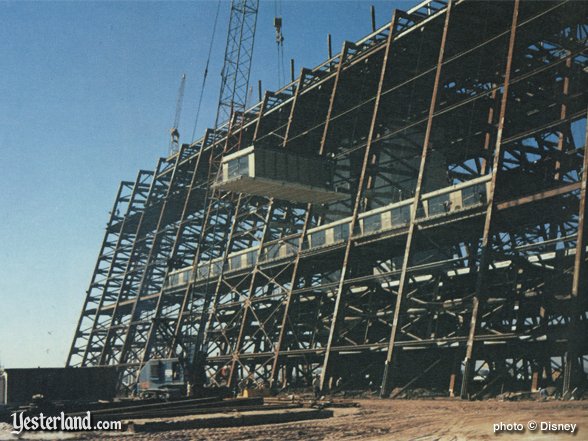
Disney’s Contemporary Resort gave its first guestrooms a ride before any guests checked in.
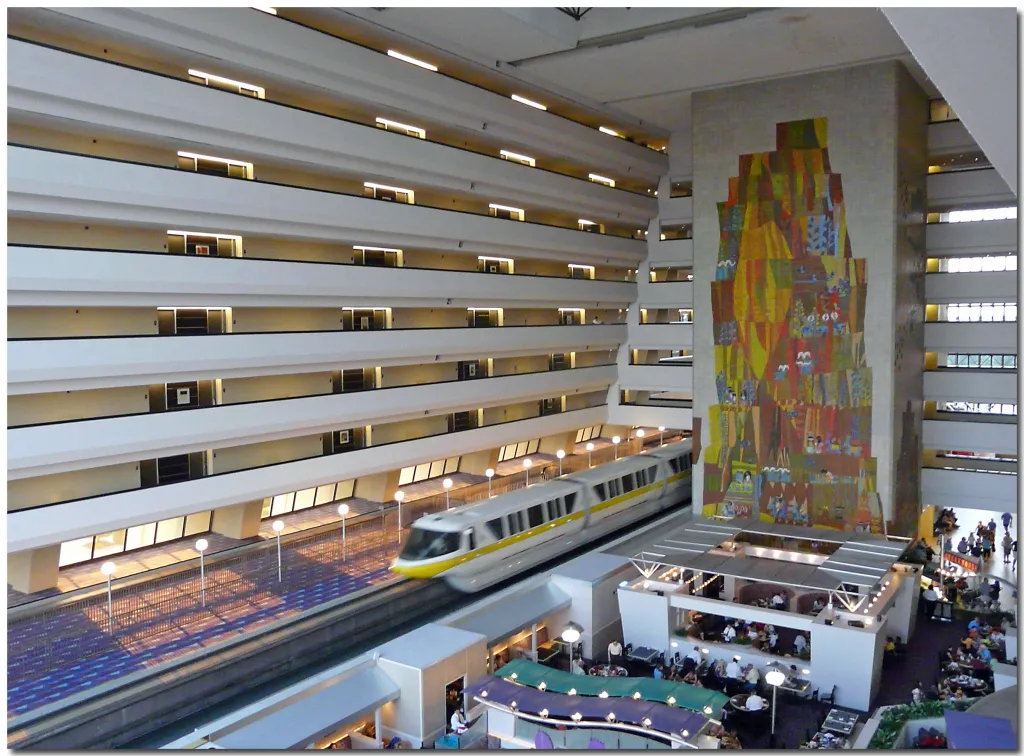
Whenever I hear someone describe modular construction as new, I think of a hotel where the bedrooms arrived by crane and the train came right through the building. Leave it to Disney to make a construction project sound like an attraction.
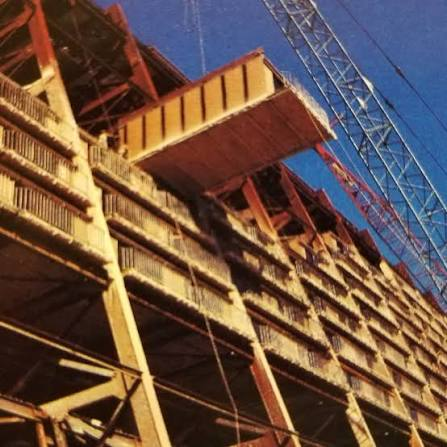
Disney’s Contemporary Resort opened on October 1, 1971, alongside the Magic Kingdom. Its enormous A-frame and indoor monorail made quite an impression. But for those of us interested in how buildings come together, the guestrooms deserve a little applause. They were built at ground level, then lifted into the hotel.
A Little Factory Behind the Magic
One small distinction is worth making: the rooms were manufactured on Disney property, but not directly at the foot of the hotel. U.S. Steel established a dedicated factory approximately three miles away, producing guestroom modules for both the Contemporary and the Polynesian resorts.
That makes the operation particularly charming to me. While visitors would eventually come to Florida to collect memories and mouse ears, this corner of Disney property was busy manufacturing bedrooms.
The approach allowed work on the rooms to proceed while crews erected the hotel structure. Rather than waiting for an upstairs workplace, room-building crews could get on with their jobs at ground level. The intention was to save time by bringing those separate construction efforts together later.


Think of it as preparing the guest bedrooms while someone else builds the place to put them.
A Bedroom With Somewhere to Go
The modules moved through an assembly-line process, receiving electrical, plumbing, and mechanical components along the way. Workers installed bathroom fixtures and mirrors before the rooms made their journey to the hotel. Trucks carried the completed modules to the building, where cranes lifted them into position.
These were furnished spaces, too. According to the Orlando Foundation for Architecture, the rooms arrived with interior finishes, furniture, and bathrooms already in place. The usual moving-day question—how will we get the furniture upstairs?—had a rather ambitious answer: take the bedroom with it.
I can picture the imaginary front-desk announcement: “Your room is ready, folks. Please give us a moment to attach it to the building.” Nobody needs to have actually said it for the construction photographs to make you smile.
Even Disney Had to Make the Pieces Fit
Of course, a crane operator cannot sprinkle a little pixie dust on a module and expect it to settle neatly into place. This was construction, with the careful coordination that any factory manager or set crew would recognize.
Disney historian Jim Korkis described installation challenges in a Yesterland interview, including modules that did not fit their openings on the first attempt. The team also alternated installation between opposite sides to keep the structure balanced.
That is the part I suspect our industry would appreciate most. Behind the futuristic appearance were people working through a very familiar assignment: getting what was built over there to fit precisely into what was built over here.
Mickey might have been the public face of the operation, but somebody still had to check the measurements.
These Rooms Were There to Stay
The construction method helped inspire a persistent story that the rooms could later be pulled out and replaced like dresser drawers. It is an appealing image: dislike the wallpaper, order a replacement bedroom.
But the original modules remained in place as interiors were updated, according to the Orlando Foundation for Architecture.[1] Changing the furnishings was a considerably more practical proposition than giving an entire guestroom another crane ride.
Gary’s Observation

What I enjoy about this story is that the factory work became almost invisible once the hotel opened. Guests could admire the monorail, settle into their rooms, and begin their vacations without thinking about how their bathrooms had reached that elevation.
That is a lovely compliment to modular construction. The manufacturing is fascinating, but the finished space simply gets on with being a comfortable place to stay.
And if anyone tells you factory-built rooms cannot have a little magic, remind them that Disney’s guestrooms were taking rides before the guests arrived.