An offsite factory doesn’t simply manufacture buildings. It operates in a space where manufacturing discipline collides with construction realities, logistics constraints, regulatory oversight, and real estate economics. That intersection is messy, constantly shifting, and unforgiving. From day one, it demands someone who isn’t just running the business, but is continually questioning where the next failure point might appear. Visionaries in offsite are the ones who look beyond today’s production schedule and ask what will break tomorrow when volume increases, codes change, labor tightens, or customers expect something different. When that mindset disappears, the factory loses more than inspiration—it loses direction.
The “Boss Phase” Trap
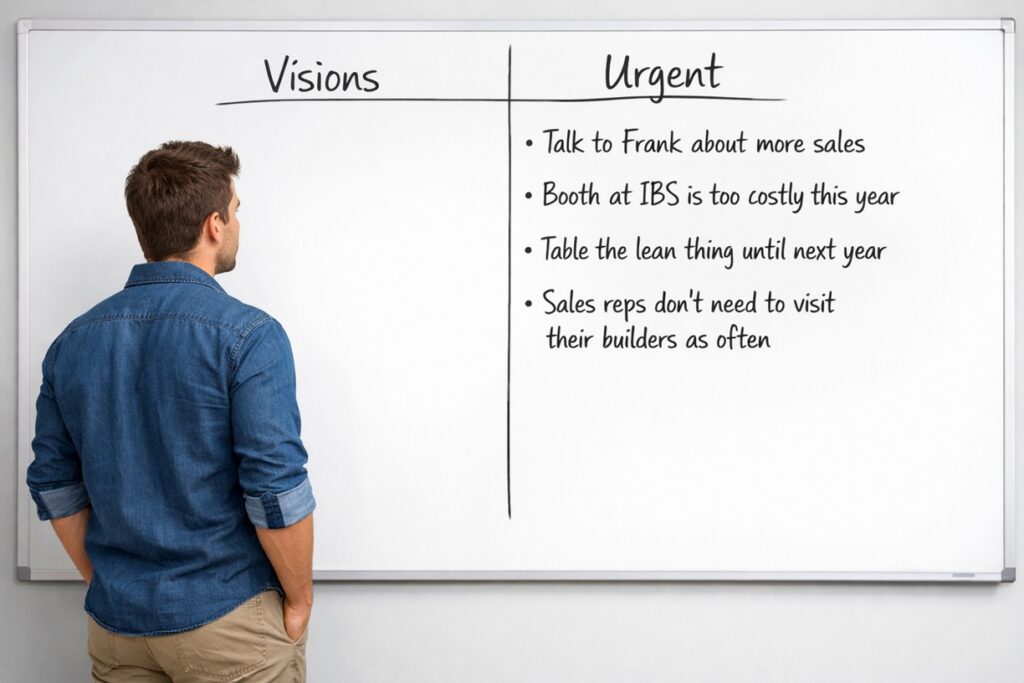
Most founders don’t abandon vision intentionally. It happens gradually. After years of pushing uphill, the factory reaches a point of stability. Orders are coming in, production feels predictable, and the chaos that once defined startup life begins to settle. That’s when the visionary often shifts into protection mode. Decisions that were once driven by possibility become shaped by caution. The question subtly changes from “What should we try next?” to “How do we avoid disrupting what finally works?” In offsite construction, that shift is risky. Stability is not the same as sustainability, and protecting the current model can quietly prevent the next necessary evolution.
What Actually Breaks First
The early warning signs are rarely financial. They show up in behavior. Middle managers stop offering ideas because they’ve learned those ideas won’t be welcomed. Strong performers begin to disengage or leave, not dramatically, but quietly. Innovation starts to feel like a threat instead of an opportunity, and competitors appear more confident, more curious, and more willing to experiment. The factory may still be producing homes, but it has stopped learning how to build the next version of itself.
The Real Risk Isn’t Control—It’s Vacuum
Many founders believe that stepping away from vision is a sign of maturity, a way to professionalize the company. That only works if vision is intentionally handed off or built into the organization’s systems and culture. When no one is empowered to think ahead, challenge assumptions, or question sacred processes, a vacuum forms. The factory becomes extremely good at repeating what it already knows, even as the world around it changes.
The Hard Truth
Offsite factories rarely fail because of bad ideas. More often, they struggle because a once-successful idea is treated as untouchable. When the visionary becomes only “the boss,” the factory isn’t doomed—but it is exposed. The solution isn’t removing founders or forcing change for its own sake. It’s making sure that vision never leaves the room, even when the person who first carried it no longer does.
CLICK HERE for a free one-hour advisory video call

Gary Fleisher—known throughout the industry as The Modcoach—has been immersed in offsite and modular construction for over three decades. Beyond writing, he advises companies across the offsite ecosystem, offering practical marketing insight and strategic guidance grounded in real-world factory, builder, and market experience.