For builders and developers exploring offsite construction—whether for single-family homes or multi-family projects—the first step often feels straightforward.
Call a modular manufacturer. Ask about pricing. Talk schedule. See what’s possible.
After more than four decades inside modular manufacturing and operations, I can tell you that this is where many projects quietly get off on the wrong foot.


Because the most important question doesn’t come up early enough.
It’s not about square footage.
It’s not about lead time.
And it’s not even about cost.
The first question should be:
Who is helping me evaluate this decision—and what real-world experience are they bringing to the table?
Modular construction isn’t a product you buy.
It’s a system you enter.
And systems have consequences.
Experience Isn’t a Credential — It’s a Risk Filter
One of the most common early assumptions builders make is that modular experience is transferable across project types.
It isn’t.
Single-family and multi-family modular construction may share vocabulary, but they operate under very different constraints. The moment repetition, stacking, fire separation, logistics sequencing, and site coordination enter the picture, the margin for error shrinks fast.
Lesson learned:
I’ve seen capable single-family factories accept multi-family work with the best intentions—only to discover midstream that their production rhythm, engineering assumptions, or scheduling logic simply didn’t translate. By the time that reality surfaced, redesign costs and schedule pressure were already locked in.
That’s not a failure of effort.
It’s a failure of early evaluation.
Who You Talk To Determines What You Learn
Early conversations almost always start with sales.
Salespeople are important. They open doors. They explain process. But they are rarely the people who feel the pain when assumptions break down on the production line.

That’s why one of the most overlooked questions is:
“Who inside the organization is ultimately accountable for production, scheduling, and delivery—and when do they get involved?“
Lesson learned:
On more than one occasion, I’ve watched projects move forward based on well-meaning assurances, only to stall when operations leadership later flagged constraints that were always there—but never discussed. At that point, the question wasn’t what should we do, but how do we recover.
That distinction matters.
Customization Is Easy to Promise — Harder to Absorb
Most manufacturers will tell you they can customize finishes, layouts, and systems.
Often, they can.
What builders don’t always hear is how those changes ripple through a factory designed for repetition. A deviation that looks small on paper can disrupt workflow, reduce throughput, or create bottlenecks that affect other projects already in the queue.
Experienced advisors don’t ask can this be done?
They ask what does this change cost the system?
If that question isn’t asked early, the answer usually arrives later—in pricing adjustments, extended schedules, or uncomfortable trade-offs.
Scheduling Conflicts Rarely Announce Themselves
Many modular manufacturers balance repeat single-family customers with project-based work.
There’s nothing inherently wrong with that.
The risk comes when builders assume their project will be treated as a priority without understanding how production sequencing actually works. Design start dates, line start dates, and shipment dates are not the same thing—and confusion between them is a frequent source of frustration.
Experienced guidance helps translate those terms into reality before commitments are made.
A Factory Visit Should Confirm — Not Educate
Factory tours are valuable. But they’re most valuable when they validate information you already understand.
When builders arrive without having vetted experience, capacity, design process, and scheduling logic in advance, the visit becomes a sales presentation rather than a due-diligence exercise.
Plant cleanliness, quality control procedures, line flow, storage practices—these details only matter when viewed through an informed lens.
That lens doesn’t come from optimism.
It comes from experience.
The Costliest Mistake Isn’t Asking Too Many Questions
Builders sometimes worry about pushing too hard or asking questions that feel uncomfortable.
In practice, experienced manufacturers respect informed buyers.
The real cost lies in proceeding without clarity—because once design begins, deposits are placed, and schedules are announced, leverage shifts. What could have been evaluated calmly becomes something that must be managed under pressure.
And pressure is rarely where good decisions are made.
Up Next:
Why size, weight, and dimensional assumptions quietly determine transportation cost, crane time, site sequencing—and why many builders don’t discover this until it’s too late. They many times just don’t know what they don’t know.
If you’d like to explore this further, connect with me today.
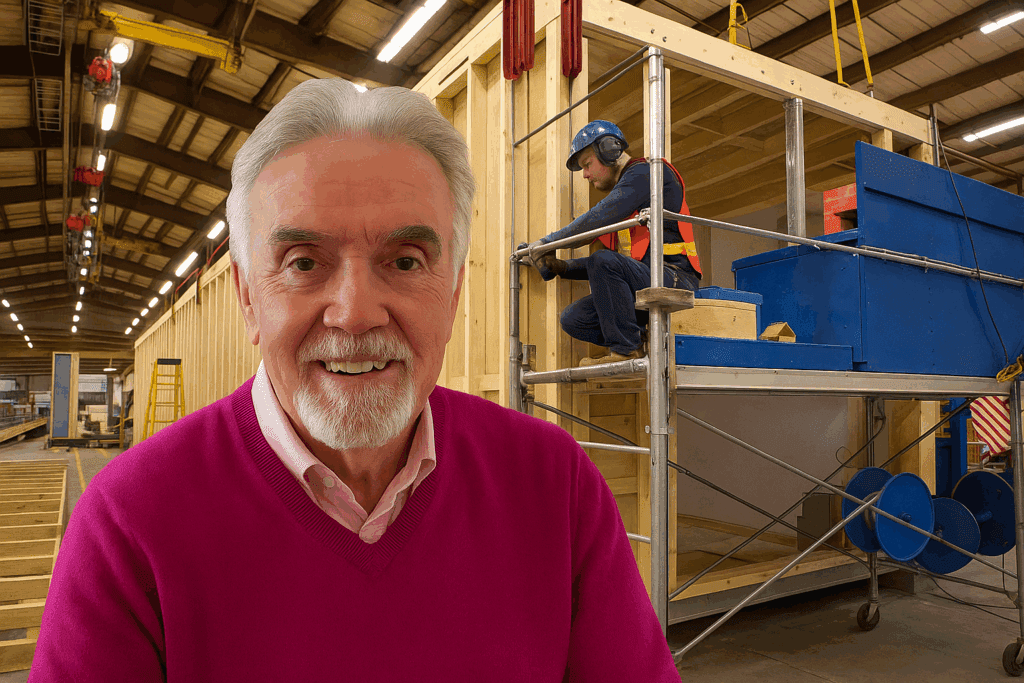
Bill Murray, Co-Founder of Offsite Innovators