Sometimes the smartest startup begins with something already working.
Whenever the idea of starting a modular home factory becomes the mission, I’m always surprised by how few startup principals seriously consider buying an operating factory instead of building a new one from scratch.
Most startup teams arrive with a vision of something different. They want advanced automation, robotics, artificial intelligence, sophisticated software, fewer employees, faster production and a building system unlike anything the modular industry has seen before. They imagine a sparkling new factory designed around their product, their equipment and their ideas.
I understand the attraction. Starting with a blank sheet of paper feels exciting, modern and limitless. Unfortunately, blank sheets of paper can also become very expensive.
The Appeal of Starting Fresh
A new factory allows startup founders to choose the location, design the production line, select the equipment and build the culture they want. They are not inheriting another owner’s processes, aging machinery, employee habits or outdated way of doing business.
To many founders, an existing modular factory represents the past. The building may not be in the ideal location, the production line may depend heavily on manual labor, and the company may build conventional modular homes rather than the innovative product the startup wants to introduce.


That is usually when we hear some version of, “We don’t want to inherit someone else’s old-fashioned ideas.”
What these teams sometimes fail to recognize is that they are not merely rejecting old ideas. They may also be rejecting experienced employees, trained production supervisors, established suppliers, proven quality-control procedures, state approvals, builder relationships and years of hard-earned manufacturing knowledge.
Not everything old needs to be thrown away.
A Factory Is More Than a Building
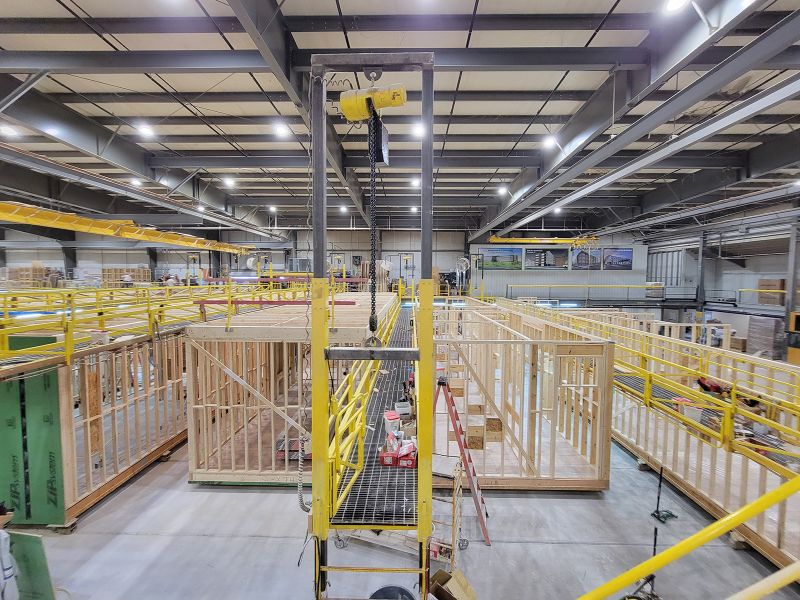
Startup teams often focus heavily on the physical factory. They study square footage, ceiling height, column spacing, crane capacity, production flow, and access to major highways. All of those things matter, but the building is only one part of a modular manufacturing operation.
A functioning factory contains something much harder to purchase than equipment: institutional knowledge.
The people working there know how to receive materials, schedule production, resolve plan discrepancies, manage inspections, coordinate deliveries and keep houses moving through the line. They understand what happens when a supplier misses a shipment, a builder changes a specification or a module fails an inspection.
Those lessons were often learned through expensive mistakes. A startup building from scratch will probably have to learn many of them again—and pay for every lesson.
Buying Time May Be the Greatest Savings
The cost of building or converting a facility is only the beginning. A new modular factory may require architectural and engineering work, permitting, utility upgrades, production equipment, material-handling systems, offices, software, code approvals and months of employee recruitment and training.
During all that time, money is flowing out while very little is coming in.
An existing profitable factory may already have a trained workforce, approved building systems, established vendor accounts, customers, projects in production and revenue arriving through the door. It may not be the founder’s dream factory on the day it is purchased, but it provides something most startups desperately need: a running start.
Automation, robotics and AI do not have to be abandoned. They can be introduced gradually where they provide measurable improvements instead of becoming enormous upfront investments based on assumptions that have not yet been tested.
The Existing Factory Can Become the Classroom
A smaller profitable factory could provide an inexperienced startup team with a real-world education in modular manufacturing. Instead of attempting to learn everything while simultaneously designing a new product and commissioning a new factory, the founders could begin by understanding an operation that already works.
They would see where production slows, where labor is wasted, where material is damaged and where automation might genuinely improve throughput. They could test their ideas inside an operating business before spending millions of dollars building an unproven manufacturing system around them.
That approach may not produce as many exciting renderings or press releases, but it could produce better decisions.
There is nothing preventing a startup from buying an existing factory, learning from it, improving it and eventually expanding into a larger or more automated facility. The acquired company could become the foundation of the larger vision instead of being viewed as an obstacle to it.
Existing Does Not Automatically Mean Worth Buying
Buying an operating factory is not without risk. Some factories are offered for sale because the owner is retiring or has no successor. Others may have declining sales, outdated approvals, deferred maintenance, environmental problems, employee issues or financial obligations that are not immediately obvious.
A factory that appears profitable may depend too heavily on one customer, one salesperson or one owner who personally holds the business together. Its backlog may look impressive until someone studies whether those projects are actually profitable and adequately funded.
That is why proper due diligence is essential. The buyer must examine the financial records, contracts, customer concentration, workforce, approvals, equipment, real estate, warranty exposure and reputation of the business. Buying the wrong factory can be just as dangerous as building the wrong one.
However, the existence of risk is not a reason to dismiss every acquisition opportunity. It is a reason to bring in people who know what to examine before the purchase is made.
Ego Can Become an Expensive Line Item
Some startup founders want to point to a new factory and say, “We built this.” They want their own production system, their own technology and their own story. Investors may also be attracted to the excitement of a futuristic factory filled with automation and big promises.
Buying a modest operating factory does not always generate the same attention. It may look less visionary, even when it is the more financially responsible decision.
But the goal should not be to build the most impressive factory. The goal should be to build a sustainable company that produces quality homes, serves its customers and generates enough cash to survive.
A new factory can consume millions before the first home reaches a jobsite. An existing factory might begin teaching, producing and generating revenue on the first day of new ownership.
The Opportunity Already Exists
At Offsite Innovators, we believe many opportunities for startup companies are sitting inside existing factories. Over the years, Bill Murray and I have advised factory owners who were ready to retire, transition their businesses or simply leave the industry. We have also advised startup teams trying to assemble the right leadership, locate a facility and understand what it really takes to manufacture modular housing.
What continues to amaze both of us is how often younger startup teams refuse even to consider an existing operation. They would rather raise significantly more money, spend years preparing a new facility and accept all the risks of starting production from zero.
Sometimes starting from scratch is the right decision. A unique product, specialized process or geographic requirement may make an acquisition impractical. But that conclusion should come after existing factories have been investigated—not before they have even been considered.
Gary’s Observation

The modular industry does not lack factories. It lacks enough serious buyers willing to look beyond the age of the building, the existing production line and the fact that somebody else started the company.
An older, smaller and profitable modular factory may not resemble the futuristic operation pictured in a startup founder’s presentation. However, it may contain the workforce, approvals, supplier relationships, customers and manufacturing knowledge needed to turn that presentation into a real business.
Before spending millions to pour floors, install equipment and learn modular manufacturing through trial and error, startup teams should at least investigate whether an existing factory could provide a faster, safer and less expensive path into the industry.
And if a factory owner is thinking about transitioning out of the business—or a startup team wants help determining whether buying an existing factory makes sense—Bill Murray and I are only an email away.