
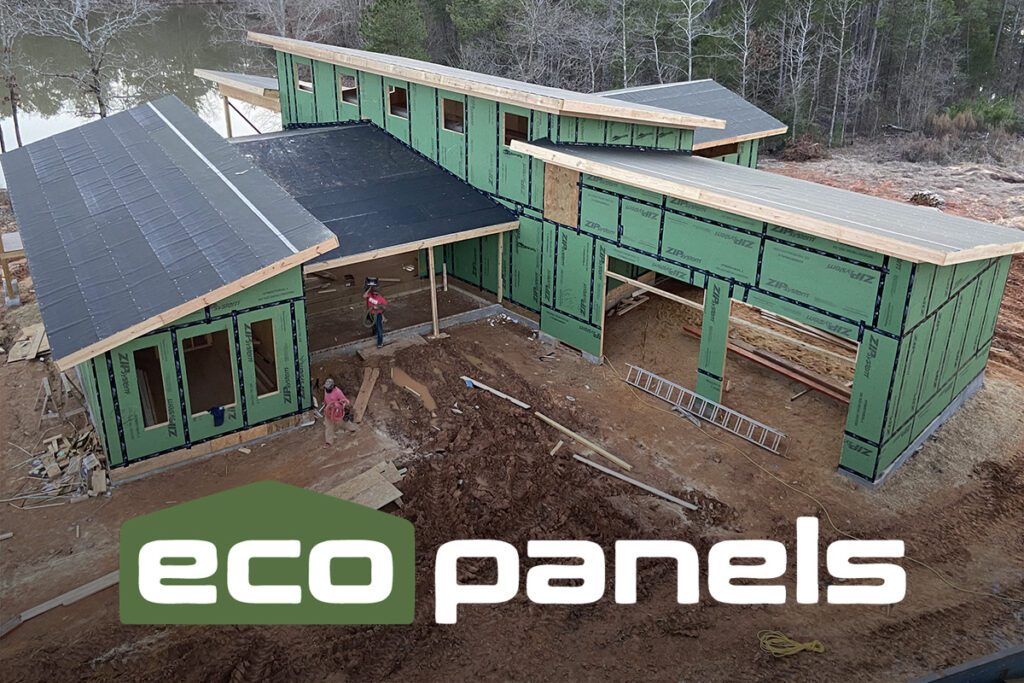
Builders today are operating in a very different environment than they were even a few years ago. Labor volatility, tightening energy and fire codes, more frequent extreme weather events, and rising buyer expectations around comfort and efficiency have all converged into a new reality.
Increasingly, the building envelope is no longer just a design choice — it has become a business, risk, and execution decision.

Charles Leahy, President & CEO of Eco-Panels
In this builder-focused conversation, we spoke with Charles Leahy, founder of Eco-Panels, about what he is seeing in the field, where traditional construction methods are beginning to strain under new demands, and how next-generation envelope systems are being evaluated by builders who want more predictability, speed, and long-term performance.
A Builder’s Conversation with Eco-Panels
Written Interview with Charles Leahy, Founder – Eco-Panels. The expert on a critical aspect of Building Sciences—the building envelope.


Bill Murray Offsite Innovators:
From your perspective, what has changed most for builders over the past few years that has forced them to rethink the building envelope?
Charles Leahy, Founder – Eco-Panels;
The world is changing. The weather is changing. Energy prices are rising. And building codes are getting tighter, requiring higher structural requirements, greater insulation requirements, and now in many jurisdictions a blower door test before a home can pass local building code.
After a spate of devastating weather events in North Carolina in the mid-2000s, the section of building code related to shear walls more than doubled in size from prior editions. We are hearing from builders across the South that they are seeing greater pressure from states and local jurisdictions to build stronger homes. More aggressive fire code requirements are also being pushed down into residential construction in some states — something that, beyond a 15-minute thermal barrier, was traditionally limited to commercial or multifamily work.
State and county jurisdictions are reacting to what they are seeing as stronger weather events across the country — whether wind- or fire-related — and they are driving construction toward a higher standard.
Bill Murray Offsite Innovators:
When builders first look at higher-performance envelope systems, what do they typically assume will be the biggest challenge — and where do you see that assumption breaking down in practice?
Charles Leahy:
I believe the greatest hurdle in achieving a high-performance building envelope is addressing thermal bridging. Builders often ignore this defect of traditional construction unless they are required by local code to address it.
If a builder wants to reduce thermal bridging using traditional materials, they face significant additional labor and materials to wrap the entire wall system in exterior insulation, and then deal with the complexity of attaching siding. Most builders do not pursue this route.
If thermal bridging is ignored, the focus often shifts to tightening the building envelope to pass a blower door test. Once that happens, builders must also address ventilation and indoor air quality, which can become quite involved. HVAC systems must be properly sized rather than relying on traditional rules of thumb.
The lowest-hanging fruit is often fenestration — better-performing windows and doors — since they are installed regardless. But focusing only on fenestration does not make a home truly high performance. Builders need all four elements working together: reduced thermal bridging, a tight envelope, properly sized HVAC with controlled ventilation, and quality fenestration.
Just as important, high-performance wall systems must never allow conditions that lead to mold, rot, or mildew. We have seen many cases where well-intentioned designs created serious moisture problems because permeability and air gaps were not properly accounted for.
Bill Murray Offsite Innovators:
Much of the conversation around panels focuses on materials and performance numbers. In your experience, what do builders care about first once they’re actually building homes at scale?
Charles Leahy:
Speed of installation. That is where our product shines for builders.
With Eco-Panels, there is no nailing of multiple splines and far fewer fasteners at panel joints. Window and door openings are pre-framed at the factory rather than being cut and framed on the jobsite. Because our closed-cell polyurethane foam core panels deliver greater insulating efficiency than traditional SIPs, builders can also gain more usable square footage — sometimes the equivalent of an entire small room.
One point that often gets overlooked is that people do not live in a panel — they live in an assembly of panels. The strength and performance of the home depends on how those panels come together. Traditional spline-based systems introduce many opportunities for error. By reducing construction complexity, Eco-Panels allow even lower-skilled workers to more consistently build stronger, higher-performing envelopes.
Bill Murray Offsite Innovators:
Eco-Panels is often described as a “high-performance” solution. From a builder’s standpoint, what does that actually mean day-to-day on a jobsite?
Charles Leahy:
It means faster installation, fewer inspections, and getting to a dried-in structure much sooner.
From repeat builders, we often hear that they can save roughly a month on the construction schedule. We have also had DIY builders achieve a certificate of occupancy in as little as nine weeks. Speed of erection is not typically associated with high performance, but when builders can take advantage of it, it becomes a meaningful benefit.
Bill Murray Offsite Innovators:
You’ve worked with both professional builders and highly capable DIY customers. What lessons from those experiences are most relevant for builders who may be evaluating envelope systems for the first time?
Charles Leahy:
Plan ahead.
Builders often tell me after the fact how valuable it was to work through the details in advance rather than reacting to whatever their framers delivered on site. Too often, builders trust trades to follow drawings precisely, only to discover downstream issues — sometimes starting with foundations that are slightly out of tolerance and affect everything that follows.
Builders are often very good at managing chaos and steering projects back on course. But working through envelope decisions early tends to improve outcomes for everyone and can significantly speed the overall process, even though many builders are not used to doing so.
Bill Murray Offsite Innovators:
For builders who sense that labor, codes, and buyer expectations are moving faster than traditional construction methods, what advice would you offer as they evaluate next-generation envelope systems?
Charles Leahy:
Find a system that is complementary — and accretive — to your existing toolbelt. It should add value by allowing you to build faster and better, not simply introduce a new learning curve while still requiring heavy labor.
If eliminating thermal bridging is a goal, Eco-Panels accomplish that by removing vertical studs altogether. If skilled labor availability is a concern, Eco-Panels combine framing, insulation, and sheathing into a single step that can be executed with fewer, lower-skilled workers.
If meeting the latest energy codes is a challenge, builders should choose systems that are inherently code-forward, offering insulation levels well beyond minimum requirements. And for air sealing, panel systems with interleaved edges and embedded cam-locks — rather than splines — can deliver airtightness that is far ahead of traditional approaches.
When we hear of blower door results above 1.0 ACH50, we often wonder whether a window was left open or a vent fan was not sealed.
Bill Murray Offsite Innovators:
Indeed, the world is changing! Offsite panel manufacturers like Charles Leahy at Eco-Panels are ahead of the curve. Thanks to Charles for sharing his insights into a whole new concept in panelization as a viable offsite alternative for the homebuilding industry.
If you’d like to explore this further, contact Bill today.

Bill Murray, Co-Founder of Offsite Innovators
Reader interactions
One Reply to “Why Builders Are Being Forced to Rethink the Building Envelope – A Conversation with Charles Leahy, Founder of Eco-Panels”
Bill, I thought there would have been more numbers relating to efficiency. Liked the questions, but think there was a missed opportunity to highlight product.
Hope this finds you well and a ornery in 2026!