
Most developers who tour a modular factory for the first time pay attention to the wrong things.
They look at the equipment. They ask about engineering capacity. They focus on pricing and maybe even look at production schedules.
All of those things matter.


But after more than forty years working in the modular industry—from sales through plant management and operations—I’ve learned that the real indicators of how well a factory operates are usually much simpler.
At Offsite Innovators, my partner Gary Fleisher and I are launching a new series of articles exploring modular construction from two perspectives.
Gary will be looking at operational excellence inside modular factories—the kinds of management practices and improvement systems that make strong plants successful.
My focus will be on what developers and builders should understand when evaluating modular construction and choosing manufacturing partners.
Because in modular construction, success rarely depends on just one side of the process. It depends on understanding how the entire system works.
One of the most common questions developers ask when considering modular construction is simple: How do we evaluate a modular manufacturer?
Factory tours are usually the starting point. But over the years I’ve noticed that many visitors focus on the wrong things or are awestruck when they walk into a plant for the first time.
They look at the newest equipment. They ask about capacity. They ask how long it takes for a home to go through the line etc. etc. etc.
Those things are certainly important. But in my experience, the real indicators of a healthy modular factory are much simpler. They are indicators.
When I walk into a plant for the first time, there are three things I look for almost immediately.
1. Cleanliness and Organization
The first thing I notice is whether the factory floor is clean and organized.
Well-run plants usually operate with a simple principle: a place for everything and everything in its place. Materials are stored where they belong. Tools are accessible. Workstations are orderly.
That level of organization rarely happens by accident. It usually reflects disciplined management and clear expectations throughout the operation.
When materials are scattered, scrap is accumulating, or workers are searching for tools, it often signals deeper problems. Disorganization on the production floor frequently reflects disorganization in scheduling, purchasing, and production planning.
Clean factories tend to be well-managed factories.
2. Are People Actually Working?
The second thing I pay attention to is the level of activity on the production floor.
In a healthy plant, you should hear the rhythm of production almost immediately—nail guns firing, staple guns firing, saw stations running, crews moving steadily from one task to the next.
Good production lines have energy. Workers know their roles and perform them with confidence.
If people appear to be standing around waiting for materials or unsure what to do next, something is usually wrong somewhere in the system.
Manufacturing depends on flow. When that flow breaks down—because of material delays, scheduling issues, or poor coordination—productivity and quality almost always suffer.
Experienced operators can sense that difference within minutes.
3. Does the Line Roll?
The third thing I watch for is whether the production line actually moves smoothly.
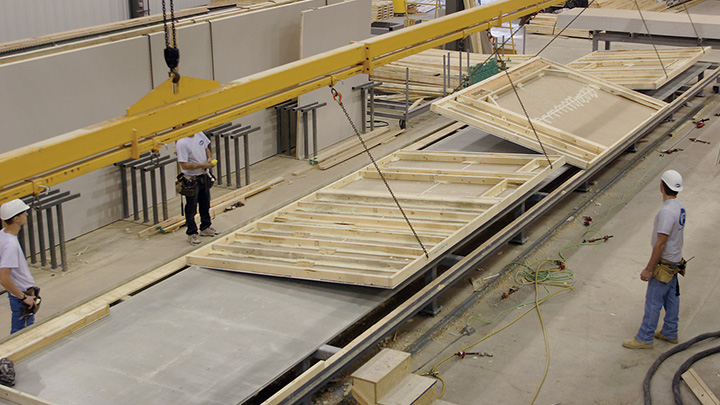
In modular manufacturing, work is completed in stages along a production line. Each station performs a set of tasks before the module moves forward to the next station.
In well-run plants, the line rolls. One station finishes its work, the module moves forward, and the next station begins. The industry term is LINE BALANCE.
But when the line is poorly balanced, something else happens—the line stalls.
One station becomes overloaded while others wait. Crews down the line stand idle while a bottleneck develops upstream.
These kinds of imbalances can quickly reduce productivity and disrupt schedules. Strong factories constantly monitor and adjust their production flow to keep the line moving.
What Developers Should Understand
None of these observations require deep manufacturing expertise. They simply require paying attention to how the factory actually operates.
That’s why developers evaluating modular manufacturers should spend as much time observing the production floor as they do reviewing presentations in the conference room.
A factory’s real capabilities reveal themselves through daily operations.
Technology matters. Engineering matters. Equipment matters. But modular manufacturing is still fundamentally a people-driven production system. Organization, discipline, and balanced production lines often tell you far more about a factory’s performance than the newest piece of equipment.
In the coming articles I’ll explore some of the practical realities developers should understand when planning modular projects—including the responsibilities that remain on the site once the modules leave the factory.
Because successful modular construction depends on more than just choosing a factory. It depends on understanding the entire system. Proper processes and systems are the essence of the matter!
If you’d like to explore this further, contact me today.
Bill Murray, Co-Founder of Offsite Innovators