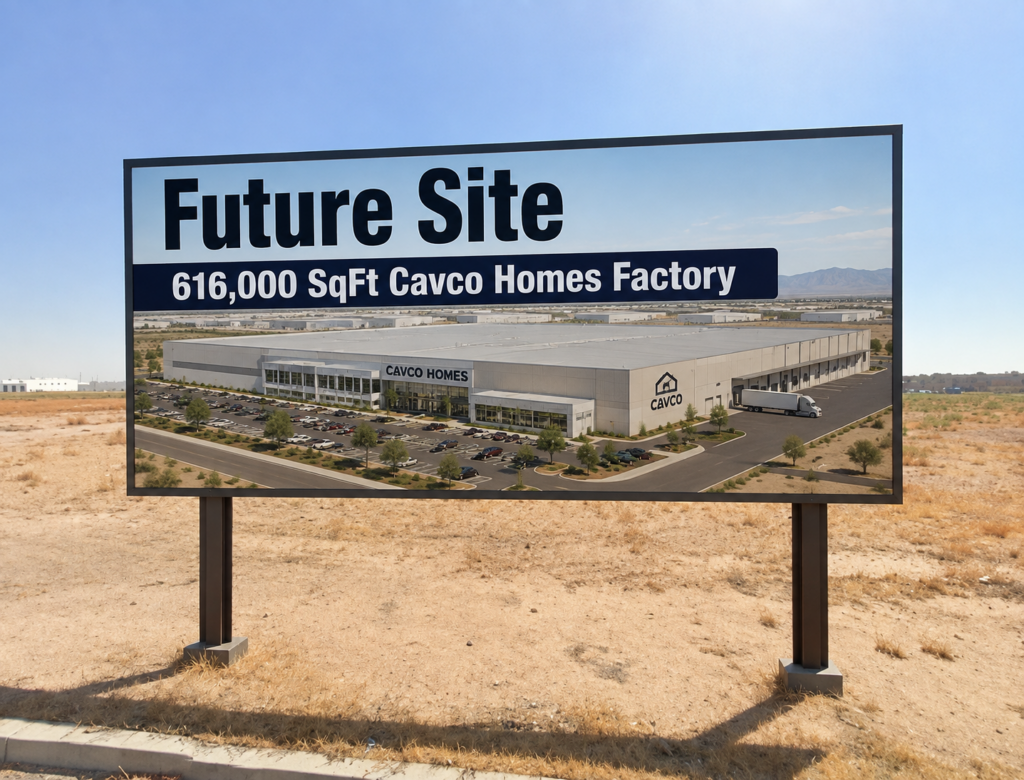
Every so often, a factory announcement comes along that makes me stop and read it twice. Cavco Industries’ decision to build a 616,000-square-foot manufactured and modular home factory in El Mirage, Arizona, was one of those announcements.
This isn’t an expansion added to the back of an existing plant, nor is it an abandoned industrial building being converted into home production. Cavco is building a new, fully temperature-controlled manufacturing campus from the ground up on approximately 39 acres in the western Phoenix metropolitan area. The company broke ground earlier this year; the walls are now going up, and production is scheduled to begin by mid-2027.
When a company with Cavco’s experience commits to a factory this large, the interesting question isn’t simply how many homes it expects to build. The more important question is what Cavco sees coming in the Southwest that convinced its leadership and board this project makes sense.
More Than a Bigger Version of an Old Factory
Cavco’s public announcement says the El Mirage facility will produce both HUD-code manufactured homes and modular single-family homes for Arizona and surrounding states. It will begin with one production line, but the building is being designed so the company can add a second line later for what it calls “modest additional capital.”
That is a carefully calculated way to approach expansion. Cavco can bring the first line online, train the workforce, refine material flow, test market demand, and correct problems before committing to full production. If demand develops as expected, much of the second-line infrastructure will already be in place.
The planning documents submitted to the City of El Mirage reveal that this is more than a giant empty building with a conventional production line running through it. The proposed campus includes a 504,000-square-foot main manufacturing building, four material-storage structures, covered storage areas, two chassis shops, administrative offices, employee facilities, and outdoor staging for finished homes awaiting transportation.


Those components total approximately 640,350 square feet, somewhat more than the 616,000 square feet in Cavco’s public announcement. That difference may reflect a design revision or simply how covered storage and accessory buildings are counted, but either number makes this one of the most significant new factory-built housing projects in the country.
The factory plans describe two mirrored production lines sharing a central cabinet shop, mill shop, and countertop fabrication area. Cavco also intends to use CNC equipment, welding fixtures, overhead cranes, paint booths, centralized compressed air, utility trenches, and dust and fume collection systems. Onsite chassis fabrication and component production should give the company greater control over quality, scheduling, inventory, and costs.
This sounds less like Cavco is building a larger version of yesterday’s manufactured home factory and more like it is trying to establish a new production model for tomorrow.
A Factory This Large Needs More Than Demand
Cavco expects to employ approximately 228 people when the plant opens. Employment could eventually grow to 455, although the planning documents indicate about 372 employees would be onsite when both lines are operating at the expected level.
That is a substantial workforce to recruit, train, and retain in one of the country’s fastest-growing metropolitan regions. The factory may be automated in important areas, but homes will still require skilled people who understand framing, electrical work, plumbing, roofing, cabinetry, finishing, quality control, material handling, engineering, and production management.
The labor question may prove almost as important as the housing demand question. A state-of-the-art building does not automatically create a state-of-the-art operation, especially during the first year when equipment, processes, suppliers, supervisors, and new employees are all learning to work together.
Then there is downstream capacity, which rarely gets as much attention as the factory. More homes leaving El Mirage will require more retailers, developers, land, financing, permits, transporters, set crews, foundations, utility connections, and local jurisdictions willing to accept manufactured and modular housing.
Factories can increase production much faster than communities can approve subdivisions or install infrastructure. Cavco may be able to build hundreds or even thousands of additional homes, but those homes still need somewhere to go when they reach the end of the production line.
What Market Is Cavco Preparing to Serve?
The Southwest continues to struggle with housing affordability, population growth, land costs, and a shortage of attainable entry-level homes. Arizona, Nevada, New Mexico, California, Colorado, and parts of Texas all present possible opportunities, but they are not one uniform market.
Each state brings its own transportation distances, zoning restrictions, energy requirements, labor conditions, financing challenges, and attitudes toward factory-built housing. A home that works competitively in rural Arizona may face an entirely different set of costs and approvals in suburban California.
Cavco has said the plant will produce both manufactured and modular single-family homes, which gives it more flexibility than a factory committed to one product category. The HUD-code side can serve retailers, land-lease communities, individual homebuyers, and developers. The modular side could potentially serve subdivisions, build-to-rent projects, workforce housing, infill lots, and other developments requiring state or locally approved construction.
What Cavco has not publicly disclosed may be more interesting than what it has announced. We do not yet know the expected number of floors per day, the intended product mix, the amount of automation, the investment required, or whether production will supplement or eventually replace capacity at older Cavco facilities in the region.
We also do not know whether large developers, communities, retailers, or institutional buyers are already helping support the business case. Companies rarely build a factory of this size based solely on the hope that individual buyers will appear after the doors open.
Cavco reported record annual production of 34,745 factory-built modules in its latest fiscal year, a 7.1% increase over the previous year. That suggests the company is expanding from a position of operating strength rather than trying to rescue a declining business. Still, adding capacity is one thing; feeding it with profitable, repeatable orders is another.
A Test of the Entire Housing Delivery System
The El Mirage factory could become an important test for more than Cavco. It could show whether the manufactured and modular housing industries can finally connect modern production capacity with the land, financing, zoning, transportation, installation, and development systems needed to deliver homes at scale.
For years, we have heard that offsite construction is the answer to America’s housing shortage. I believe it can be part of the answer, but the industry sometimes talks as if building more factories automatically produces more affordable housing.
It doesn’t. A factory produces the home, but affordability depends on the entire chain from the first engineering drawing to the day the homeowner gets the keys.
If land prices, impact fees, site work, transportation, financing, zoning delays, utility costs, and installation expenses keep climbing, even an extremely efficient factory will struggle to deliver the affordability promised in the press release. Cavco’s challenge will be to make the new plant more than a production achievement. It must become part of a coordinated housing delivery system.
Gary’s Observation

The size of Cavco’s El Mirage project tells me that this is not a casual expansion. A 616,000-square-foot facility with room for two production lines, onsite chassis fabrication, central component shops, advanced equipment, and nearly 500 potential employees represents a long-term wager on factory-built housing in the Southwest.
Cavco may be anticipating stronger demand from developers, changing zoning attitudes, wider acceptance of HUD-code homes, growth in modular subdivisions, or financing programs that have not yet reached the broader market. It may also believe many older factories simply will not meet future expectations for production efficiency, employee working conditions, quality control, and product flexibility.
The factory itself is impressive, but its real importance will not be measured in square feet. It will be measured by how many homes it can produce profitably, how quickly those homes reach prepared sites, and whether families can actually afford the final delivered price.
Maybe Cavco simply believes the Southwest needs a lot more homes. Or perhaps it knows something about the next stage of factory-built housing that the rest of us are only beginning to see.