Fifth in a series on improving the Bottom Line by 1% and more (For a list of all the articles, go to the end)
Paper profits don’t pay bills—timing does, every single time.
There’s an uncomfortable truth in offsite construction that most owners, GMs, and even seasoned builders don’t like to talk about until it’s too late. You can be profitable on paper, busy in production, and still feel like you’re one delayed draw away from a sleepless night.
I’ve lived this from both sides—first as a General Contractor juggling multiple builds with draws as my lifeline, and later inside modular factories where the numbers looked great… until the timing didn’t.
Cash flow isn’t just a financial metric. It’s oxygen. And when it gets tight, everything else—quality, morale, decision-making—starts to suffocate.
Profit on Paper vs. Cash in the Bank
One of the biggest misconceptions I see, even today, is confusing profitability with liquidity.
Factories can show solid margins on every module rolling off the line. Builders can have signed contracts with healthy spreads. But neither of those matter when payroll hits on Friday and the draw that was “supposed to come in” is still sitting in someone’s inbox waiting for approval.
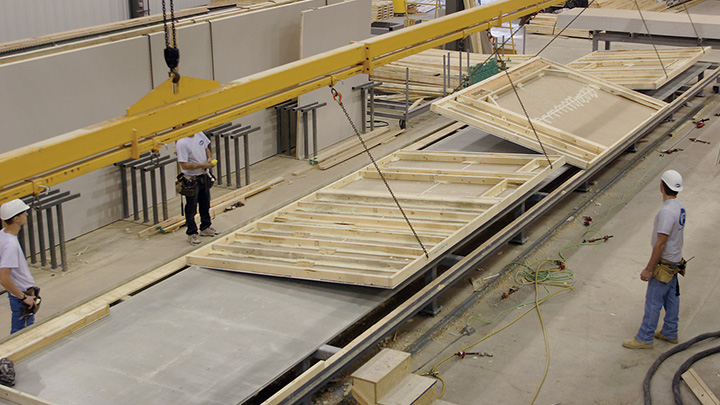
Offsite construction amplifies this problem. Unlike site-built homes where costs and progress often move in smaller increments, factories front-load labor, materials, and overhead. By the time a module leaves the building, a significant portion of the cost has already been spent.
If the draw schedule doesn’t match that reality, the factory becomes the bank.
And that’s a dangerous place to be.
The Million-Dollar Delay
It doesn’t take much for things to go sideways.
A missing inspection.
A delayed sign-off.
A lender asking one more question.
A developer waiting on their own funding source.
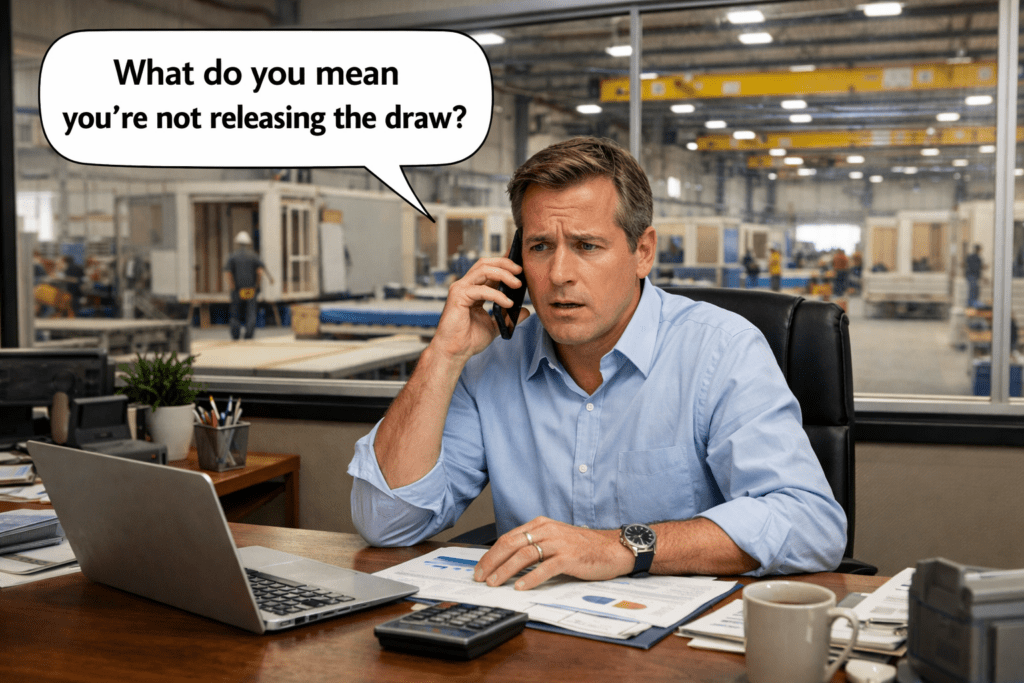
Suddenly, a draw worth hundreds of thousands—or even over a million dollars—is delayed.
The factory still has to pay for materials already installed. The crew still expects their paycheck. Vendors don’t accept “the draw is coming” as payment.
That’s when reality turns into stress.
And here’s the part no one wants to admit: it’s rarely just one delay. Once the rhythm is broken, delays tend to stack.
Matching Draw Schedules to Reality
If there’s one place where a 1% improvement can turn into real money, it’s here.
Too many factories and builders accept draw schedules that are based on tradition instead of actual cost flow.
The smarter operators take a different approach. They reverse-engineer their cash needs.
They know exactly how much cash is required at each stage of production—not just in total, but weekly. They align their draw requests to those real costs, not generic milestones.
Instead of “25% at set, 25% at delivery,” they push for structures that reflect factory reality—material deposits upfront, progress-based draws tied to production stages, and faster approval cycles.
It’s not about being aggressive. It’s about being accurate.
Knowing If the Draw Is Enough
Here’s a question I’ve asked more than a few factory owners over the years:
“How do you know your next draw will actually cover what you need?”
Too often, the answer is a version of, “It should.”
That’s not a system. That’s hope.
The factories that consistently avoid cash crunches have a rolling cash flow forecast that looks out at least 60 to 90 days. They don’t just track totals—they track timing down to the week.
They factor in:
Incoming draws and their realistic approval timelines.
Vendor payment terms and actual due dates.
Payroll cycles.
Tax obligations.
Transportation and set costs.
They stress-test their numbers. What happens if a draw is delayed two weeks? What if material costs spike mid-project? What if a builder slows down approvals?
When you run those scenarios in advance, surprises become manageable instead of catastrophic.
The Builder–Factory Tension No One Talks About
There’s an unspoken tension between builders and factories when it comes to cash flow.
Builders are often waiting on their own draws from lenders or investors. Factories are waiting on the builder.
When things go smoothly, no one notices. When they don’t, both sides feel like the other is the problem.
In reality, both are often victims of the same issue: misaligned expectations and poorly structured draw schedules.
The best relationships I’ve seen are the ones where both sides sit down early—before contracts are signed—and walk through the cash flow together. Not just the total project cost, but the timing of every dollar.
It’s not glamorous work. But it prevents a lot of uncomfortable phone calls later.
Small Fixes, Big Impact
Improving cash flow by even 1% doesn’t come from one big change. It comes from tightening the small things that most people overlook.
Faster and cleaner documentation for draw requests.
Clear responsibility for approvals on both sides.
Daily visibility into production progress tied to billing milestones.
Proactive communication when something might delay a draw.
None of these sound revolutionary. But together, they create predictability.
And predictability is what keeps the doors open.
Modcoach Observation
Cash flow problems rarely show up all at once. They creep in quietly—one delayed draw, one underestimated cost, one assumption that “it will work itself out.”
Then one day, you’re profitable on paper and scrambling in reality.
If you’re running a factory or developing projects right now, ask yourself one simple question: Do I know, with certainty, what my cash position will be 60 days from today if two things go wrong?
If the answer is anything less than a confident yes, there’s an opportunity sitting right in front of you to improve your bottom line by far more than 1%.
And if you want a second set of eyes to help you find it before it finds you, you already know how to reach me.
Other articles in this series:
When Developers and Builders Go Modular, the Learning Curve Is Steeper Than Expected
The Offsite Factory Warranty Loop That Never Closes
The Quiet Profit Killer: “When Factory Quality Slips Before It Ships”
Overhead Creep: The Silent Killer of Factory Profits

If you are serious about continuous improvement, reach out to us via email. We’ll schedule a brief phone call to explore the possibilities. Contact Gary at: [email protected], contact Bill at:[email protected]. We’ll respond promptly and schedule a brief call.