For years, the offsite construction industry has talked about automation as though every factory would eventually resemble an automobile plant. Robots would frame walls, install windows, apply adhesives, move materials, and complete repetitive tasks while a smaller number of highly trained employees monitored the production line.
That vision has proven far more difficult to achieve in homebuilding than many technology companies expected. Houses contain flexible materials, constantly changing components, tight spaces, and dozens of tasks requiring people to see, feel, and adjust what they are working with. Traditional industrial robots perform extremely well when every component arrives in precisely the same position, but construction materials do not always cooperate.
Bigwave Robotics believes humanoid robots may close some of that gap.
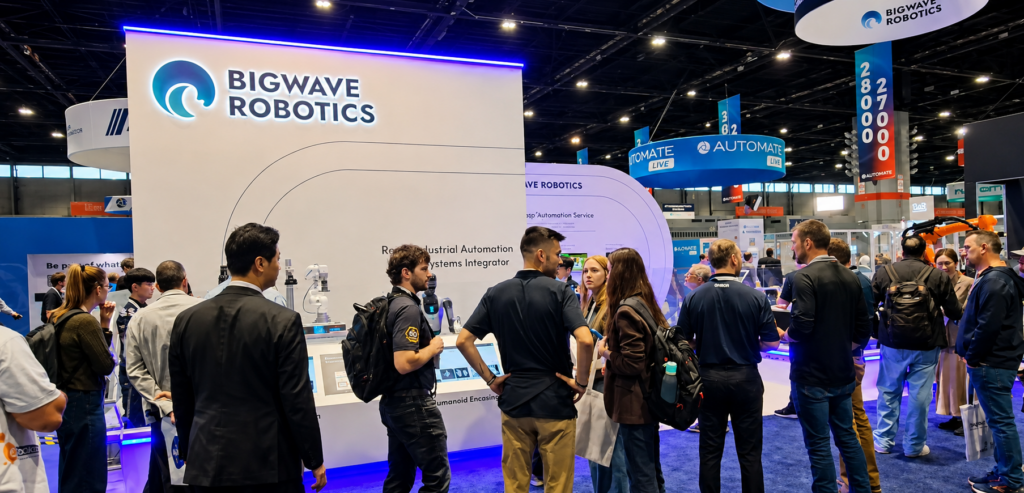
The robotics company has announced an agreement with Space Manufacturing Lab, described as the country’s largest modular housing producer, to begin introducing humanoid robots into factory production and onsite installation. The first assignment will not be framing walls, hanging drywall or carrying modules. The robots will begin with one of the least pleasant jobs in residential construction: installing fiberglass insulation.
Beginning With a Job People Do Not Want
Insulation installation may seem like a modest starting point for a humanoid robot, but it makes a lot of sense. Fiberglass can irritate workers’ skin, eyes, and respiratory systems, especially when they don’t follow proper protective equipment and ventilation procedures.

Many factories also find this task difficult to staff consistently. Employees must lift, position, cut and fit insulation into cavities while working around wiring, plumbing, framing irregularities and other obstructions. The work is repetitive, physically uncomfortable, and not the type of job most employees hope to perform for the rest of their careers.


Unfortunately, it is also difficult to automate with conventional industrial equipment. Fiberglass insulation is flexible, compressible, and irregular. It bends, folds, and changes shape when handled, making it very different from the metal parts and rigid components that robots have traditionally moved through manufacturing plants.
A fixed industrial robot performs best when the material, workstation and required movement remain virtually identical during every cycle. Insulation does not always provide that level of predictability. A humanoid robot equipped with vision systems, sensors and artificial intelligence may be able to recognize the cavity, adjust its movements and manipulate the material in ways that more closely resemble a human worker.
That is the theory. Space Manufacturing Lab and Bigwave Robotics now have to prove it works under real production conditions.
Adding Humanoids to an Existing Automated Factory
Space Manufacturing Lab already uses factory prefabrication and standardized production methods to manufacture wood modular housing. Rather than replacing its entire production system, the company plans to introduce humanoids gradually alongside its existing automated equipment and human workforce.
That approach may matter more than the robots themselves.
Factories often make the mistake of treating automation as an all-or-nothing decision. Management becomes attracted to the idea of building a highly automated plant and begins purchasing expensive equipment before determining whether the product, production volume, and processes justify the investment.
A more practical strategy is to identify a specific task that is dangerous, repetitive, difficult to staff or responsible for a production bottleneck. The factory can introduce automation at that point, measure the results, and expand only after the technology proves it can improve safety, quality, output, or cost.
Insulation gives the companies a clearly defined place to begin. Bigwave Robotics says it will use what it learns from that application to identify other factory and installation tasks that humanoids may eventually perform.
The important word is “eventually.” Introducing a humanoid robot into a promotional video is relatively easy. Teaching it to work safely and productively during an eight-hour shift, alongside employees and under changing factory conditions, is an entirely different challenge.
The Factory Must Be Ready for the Robot
Humanoid robots are sometimes presented as the answer to construction’s labor shortage because they are designed to operate in environments originally built for people. They may be able to walk through a factory, use tools, and perform tasks without redesigning every workstation.
That does not mean a humanoid can solve an undisciplined production process.
If drawings change after production begins, materials arrive late, components are stored in the wrong location, or every house differs significantly from the last, the robot will face many of the same problems that frustrate human workers. Artificial intelligence may help a machine adjust to variations, but it cannot turn a poorly organized factory into a dependable manufacturing operation.
Space Manufacturing Lab appears to understand the importance of standardization. Its modular system is based on completing much of the house in a controlled factory environment, and the company recently introduced the Samsung AI Modular Home in cooperation with Samsung Electronics. That concept combines modular construction with artificial intelligence and Internet-connected home technology.
Adding humanoid robots to the production process represents another step toward connecting the factory, the product, and the technology inside the finished home. Whether customers ultimately care who—or what—installed the insulation will depend upon the results. The finished work must still meet code, perform properly, and be completed at a cost that supports the selling price.
North America Is Clearly Part of the Plan
Bigwave Robotics intends to use the information collected at Space Manufacturing Lab’s facilities to develop construction-focused “physical AI” systems. Unlike AI programs that generate reports, drawings, or schedules, physical AI allows machines to perceive their surroundings, make decisions, and perform work in the real world.
The company has also made it clear that its ambitions extend beyond its domestic market. Bigwave Robotics plans to pursue modular housing opportunities in other countries, including North America.
That should catch the attention of U.S. and Canadian modular, manufactured and panelized housing producers. Many North American factories are struggling to recruit and retain production employees, especially for jobs involving repetitive motion, uncomfortable working conditions or physically demanding tasks.
The industry is not likely to replace entire production crews with humanoids anytime soon. The first useful applications will probably involve individual jobs that workers dislike, that contribute to injuries or that repeatedly interrupt production because people cannot be found to perform them.
Insulation, sanding, material handling, fastening, inspection and certain finishing tasks could all become candidates. Onsite work may be harder because weather, uneven terrain, changing conditions, and unpredictable obstacles make construction sites far less controlled than factories.
Automation Must Produce a Measurable Return
The robot’s cost is only part of the equation. A factory must also consider programming, integration, maintenance, safety systems, employee training, production interruptions, and the technical personnel required to keep the equipment operating.
Management must measure more than whether the robot can perform the task. It must determine whether the machine can complete the work at the required speed, maintain consistent quality, and operate often enough to justify the total investment.
If a humanoid robot installs insulation twice as slowly as an experienced employee and requires frequent human assistance, it may be an impressive technical demonstration without being a sound manufacturing investment. If it can work consistently, reduce employee exposure, improve installation quality and relieve a chronic labor shortage, it could become extremely valuable.
The factory should know the difference before ordering a fleet.
Gary’s Observation

Humanoid robots will almost certainly become part of offsite construction, but their arrival will not eliminate the need for good factory management. In fact, they may expose weak management more quickly because automation depends upon standardized products, reliable material flow, complete information, and repeatable processes.
Space Manufacturing Lab and Bigwave Robotics are beginning in the right place. They have selected a specific task that is unpleasant for employees and difficult for conventional robots. If the humanoid can install insulation safely, accurately, and economically, the companies will have demonstrated something far more useful than a robot walking across a factory floor for the cameras.
The real opportunity is not replacing every employee. It is allowing people to move away from the dirtiest, most dangerous, and least desirable jobs while machines perform the work that factories consistently struggle to staff.
Humanoid robots may be coming to modular housing, but the winners will not be the factories that purchase them first. They will be the factories that know exactly why they need them, where they should use them, and how the investment will improve the home coming off the line.