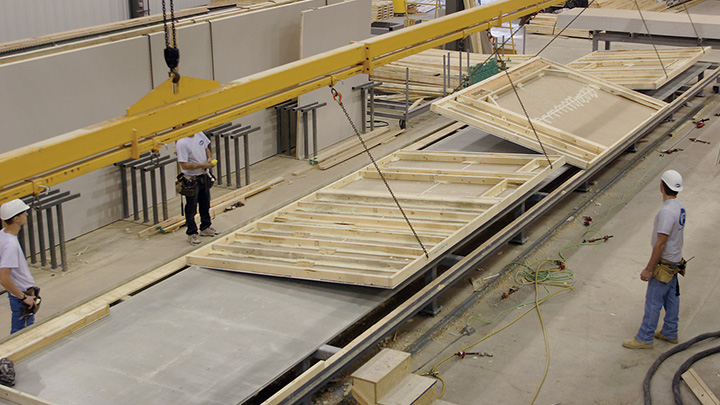
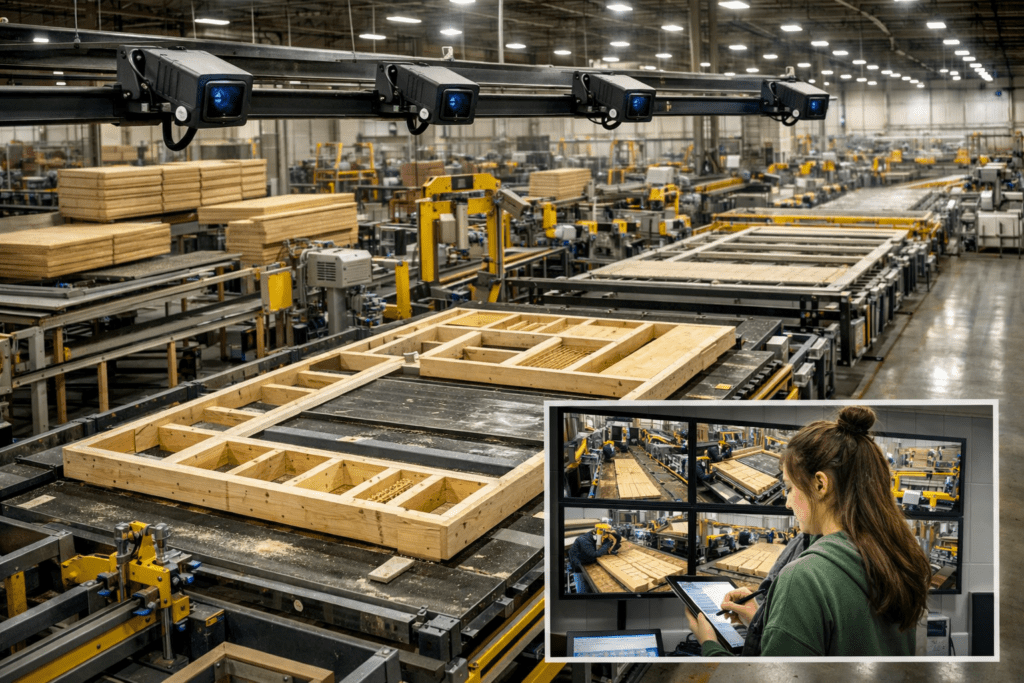
For decades, the offsite construction industry has relied on people walking the line, checking work, and trusting experience to catch what matters. Most of the time, it works well enough to keep production moving, but not always well enough to protect profits. The reality is simple—mistakes don’t usually happen because people don’t care; they happen because people can’t see everything.
Now imagine a second set of eyes on every station, watching every cut, every fastener, and every install in real time. That’s what Vision AI brings to the production line, and it’s starting to change how factories think about quality, training, and efficiency. Not in a dramatic, headline-grabbing way, but in the quiet, steady way that actually moves the bottom line.
Catching the Small Mistakes That Become Big Problems
Anyone who has spent time in a factory knows that most costly problems don’t start as disasters. They start as small oversights—a missed fastener, a slightly off layout, a connector that wasn’t installed because someone assumed it was already done. Those little issues travel down the line, picking up cost at every station until they finally show up in the field where they become expensive, time-consuming fixes.


Vision AI interrupts that chain reaction. By monitoring each station as work is being completed, it can flag issues immediately instead of hours or days later. Instead of discovering a problem at the end of the line, the person who made it can correct it on the spot, which is always the cheapest and fastest solution.
Over time, this alone can remove a surprising amount of rework from a factory’s daily operations. Not because people suddenly became better, but because the system made it easier to catch what was already being missed.
Defining “Good Enough” Out of Existence
One of the quiet challenges in any factory is the slow drift toward “good enough.” It doesn’t happen overnight, and it’s rarely intentional, but over time standards loosen just enough that quality becomes inconsistent. One crew’s acceptable work becomes another crew’s problem, and nobody quite agrees on where the line is.
Vision AI replaces that ambiguity with consistency. It creates a digital benchmark of what correct work looks like and compares every unit against that same standard. There’s no interpretation, no mood, and no “it looks fine to me” judgment call.
That doesn’t eliminate craftsmanship or experience, but it does remove the gray area that often leads to uneven results. When every unit is measured the same way, quality stops being subjective and starts becoming repeatable.
Finding Time You Didn’t Know You Were Losing
Most factory owners have a general sense of where their bottlenecks are. They know which stations feel slow, which crews are under pressure, and where things tend to back up. What they don’t always see are the small inefficiencies that add up over the course of a day.
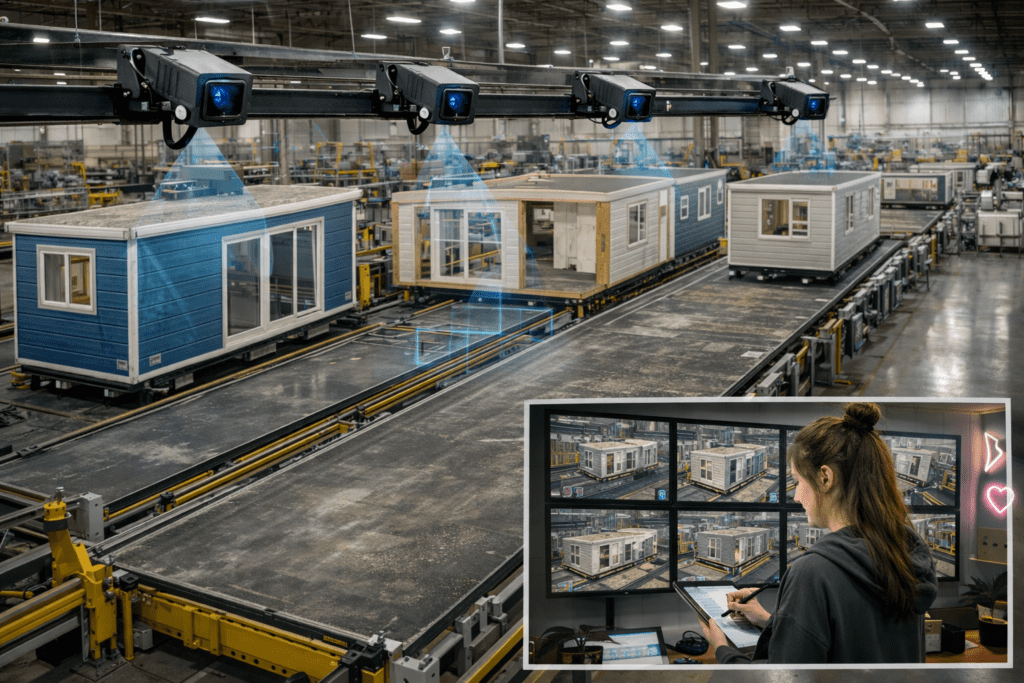
Vision AI tracks movement, timing, and workflow patterns across the entire line. It can show where workers are waiting, where materials aren’t staged properly, and where a process consistently takes longer than expected. These aren’t dramatic failures—they’re the kind of small delays that quietly eat into productivity.
When those patterns become visible, they become fixable. A few minutes saved at multiple stations can translate into meaningful gains without asking anyone to work harder or faster. It’s not about pushing people; it’s about removing the friction they’ve been working around.
Training Without Slowing Down Production
Training has always been one of the toughest balancing acts in offsite construction. New workers need to learn, but production can’t afford to slow down while they do it. Too often, that means learning happens on the fly, with mixed results depending on who is doing the teaching.
Vision AI introduces a different approach by providing real-time feedback as work is being done. Instead of waiting for a supervisor to notice a mistake, the system can highlight it immediately and show what correct work should look like. That shortens the learning curve without pulling people away from their stations.
It also creates consistency in training, which is something many factories struggle to maintain. When every worker is guided by the same standard, the variability in how people are taught begins to shrink.
A Visual Record That Changes Accountability
One of the most overlooked advantages of Vision AI is the record it creates. Every unit can be documented visually as it moves through production, creating a timeline of what was done, when it was done, and how it looked at each stage.
When a problem shows up in the field, this record becomes invaluable. Instead of relying on memory or assumptions, factory teams can go back and review exactly what left the building. That changes how warranty issues are handled and how internal accountability is managed.
It also builds confidence with builders and developers. Being able to demonstrate quality with actual data and visuals is far more powerful than simply assuring someone that everything was done correctly.
Technology Doesn’t Fix Culture
It’s important to say this out loud. Vision AI will not fix a poorly run factory, and it won’t replace strong leadership or clear processes. If anything, it will highlight where those things are missing.
Factories that treat it as a quick solution will likely be disappointed. The real value comes when leadership uses the information it provides to make better decisions, reinforce standards, and support their teams.
Like any tool, it reflects how it’s used. In the right environment, it becomes a quiet driver of improvement. In the wrong one, it becomes just another screen that people learn to ignore.
Modcoach Observation

For years, offsite factories have depended on experienced people to keep quality and production on track, and many have done it remarkably well. But as labor becomes harder to find and margins become tighter, relying on experience alone is starting to show its limits.
Vision AI doesn’t replace the people on the line—it gives them something they’ve never had before: the ability to see everything that matters, all the time. The factories that benefit most won’t be the ones chasing technology, but the ones willing to face what it reveals and make the changes they’ve been putting off.