A New Kind of Vision
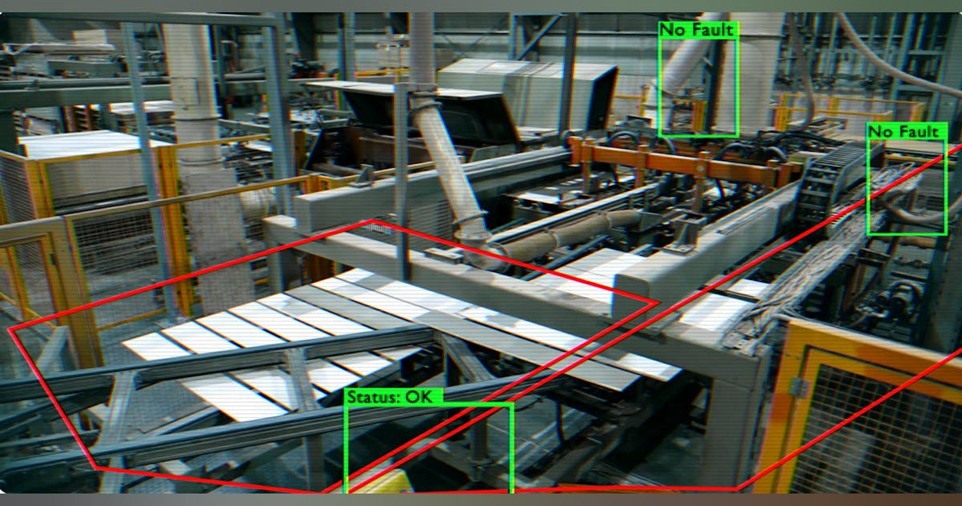
There’s a quiet revolution happening inside offsite construction factories. It doesn’t roar like a CNC saw or glow like a welding torch — it watches. AI mini-cameras, some no larger than a sugar cube, are being tested in factories from Oregon to Ontario. These aren’t ordinary security cameras. They’re self-contained, AI-powered observers capable of interpreting what they see, in real time, without needing a bulky server or a human monitor.
They’re called AI RF cameras because many of them also use radio-frequency (RF) sensing — a cousin of radar — to “see” movement even in dust, smoke, or poor lighting. Combined with onboard artificial intelligence, these cameras are fast becoming the digital eyes and nervous system of the modern modular factory.
And if their adoption continues, the phrase “factory floor supervision” may take on a whole new meaning.
Beyond Security: Watching for Productivity, Safety, and Waste
At first, most modular and offsite firms install cameras for the obvious reasons — security, site monitoring, and loss prevention. But that’s just the beginning. The new generation of AI mini-cameras comes with onboard processing units, meaning they can analyze visual data at the source instead of sending endless video to a central computer.
That single design change transforms the role of cameras from passive observers into active assistants.
Inside a framing or wall-panel line, these cameras can now:


- Count materials in real time and alert supervisors when inventory runs low.
- Track worker motion and tool usage, helping identify process bottlenecks without invading privacy.
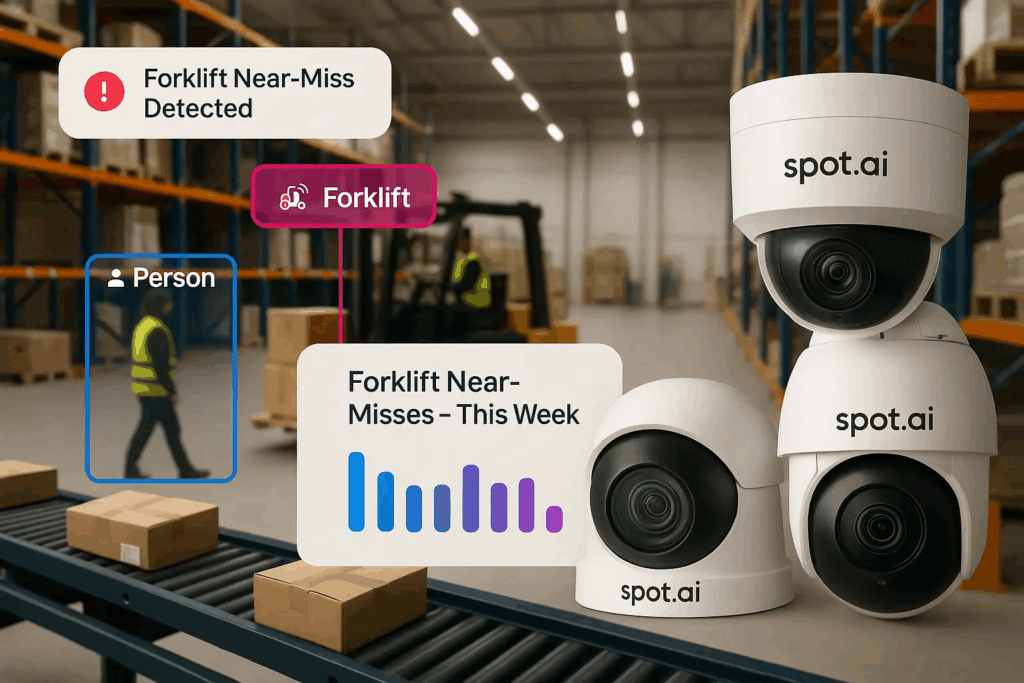
- Recognize safety violations like missing helmets, unauthorized zones, or unsafe lifting postures.
- Monitor curing rooms or paint booths for temperature anomalies or contamination.
- Send alerts only when something abnormal occurs, filtering out harmless movement like shadows, forklifts, or birds.
It’s not surveillance — it’s situational awareness.
Factories that have tested AI cameras report up to 20% productivity gains when used for workflow timing, and even greater savings by catching small mistakes before they become expensive rework.
RF Sensing: Seeing What the Eye Can’t
What makes AI RF cameras especially intriguing for modular and offsite applications is their ability to use radio frequency to “see” through obstacles like fog, dust, or temporary partitions.
Unlike visual light, RF waves can detect movement behind objects or under dim lighting. When fused with AI image interpretation, the result is a camera that doesn’t just record — it perceives.
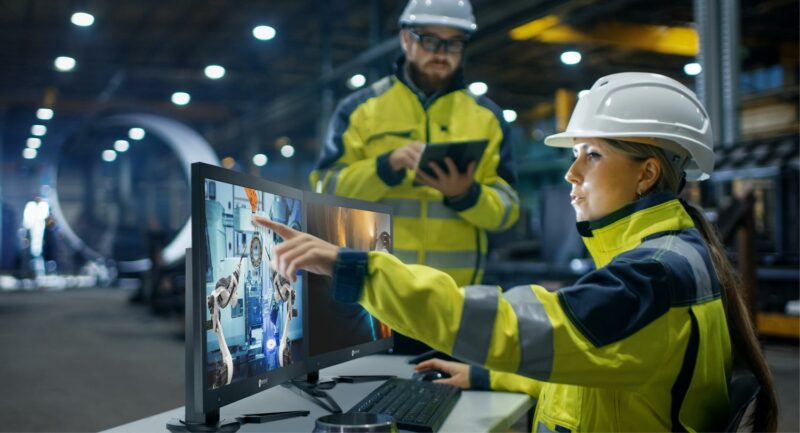
In a panel-assembly area, for example, an RF-enhanced AI camera could detect the location and speed of workers without relying on perfect lighting or line-of-sight. During installation, the same camera could verify that wall sections are lifted and placed in the correct order, even during a night set when visibility is limited.
This technology has already proven itself in logistics, defense, and autonomous vehicles, but its potential for construction safety and automation is just beginning to surface.
From Object Detection to Intelligent Factory Feedback
Today’s best AI cameras can tell the difference between a person, a forklift, or a bundle of studs. More advanced models can even identify individual workers, components, or tools — but that’s where privacy and ethics enter the picture.
One large modular manufacturer that experimented with AI cameras last year trained them to recognize specific assembly stages. When a worker completed a task, the system automatically advanced the digital work order to the next stage. The results were impressive: near-perfect traceability and smoother communication between production, logistics, and quality control.
But some line workers expressed concern: “Are we being tracked, or are our mistakes being tallied?”
Factory managers had to draw clear boundaries. The cameras monitored processes, not people. They were programmed to detect the presence of a component, not to evaluate performance. That’s a delicate but essential distinction if AI cameras are going to find acceptance across the industry.
AI Mini-Cameras on the Jobsite
The benefits don’t stop at the factory doors. For modular installation crews, AI mini-cameras can provide a new layer of safety and accountability.
Mounted on cranes or helmets, they can track lifting angles, distance between crew members, and even weather visibility. Paired with RF data, they can map the position of every module in real time, verifying that sections are aligned to within fractions of an inch.
In one pilot project, an AI camera system flagged a misalignment of just two inches before a heavy set crew lowered a unit. That alert prevented hours of rework and a potential safety incident.
Because these cameras can be powered by a simple USB port and transmit wirelessly, they can be placed virtually anywhere — including temporary pop-up factories, onsite staging areas, or transport trailers.
How They Work
An AI mini-camera differs from a typical webcam in three major ways:
- Onboard Processing:
Instead of sending raw video to a central computer, it uses an internal AI chip (often an ARM or NVIDIA Jetson module) to process video on the spot. - Real-Time Learning:
The camera doesn’t just record — it interprets. It can be trained to detect people, vehicles, machinery, or specific products like floor cassettes or truss bundles. - RF and Vision Fusion:
Advanced models integrate radio-frequency signals, allowing depth perception or through-obstacle detection even in poor lighting.
This self-contained intelligence means factories no longer need massive bandwidth or dedicated operators to extract insights. A single dashboard can display alerts, analytics, and video clips, helping supervisors monitor dozens of stations at once.
Ethical Lines and Legal Boundaries
While the technology excites innovators, it also raises uncomfortable questions.
In some regions, data privacy laws limit how and when images of workers can be recorded. AI cameras blur that line further by turning visual data into analytics — sometimes automatically. Who owns that data? The worker? The employer? The software provider?
A few unions and workforce advocates are already pushing for clear consent protocols before deployment. Transparency is key. Workers must understand that these systems are designed for process optimization and safety, not personal evaluation.
Experts recommend anonymizing data at the source. Instead of storing video, the AI camera should convert it to statistical outputs — “three wall panels completed,” or “forklift in zone three” — erasing the human element before the footage ever leaves the device.
Why Modular Factories Are Perfect Testbeds
Offsite and modular factories are far more controlled than traditional jobsites. Everything — lighting, layout, timing, material flow — follows predictable paths. That predictability makes them ideal environments to train AI systems.
Unlike chaotic outdoor construction, a modular plant can gather consistent visual data, allowing algorithms to improve faster. Within weeks, an AI mini-camera can learn to recognize a wall section, detect if it’s missing a component, and even estimate assembly time.
Companies like Framebotix, BotBuilt, and several European automation startups are rumored to be experimenting with such embedded camera systems to feed real-time performance data into their digital twins. That combination — AI eyes and digital brains — could become the foundation of fully autonomous modular manufacturing.
The Cost Equation
Five years ago, such technology would have been out of reach for small to mid-sized factories. Today, however, AI mini-cameras start under $200 each, depending on resolution and processing power. More advanced models cost $500–$1,000 but can replace multiple fixed cameras and sensors.
Their biggest savings come from what they prevent — delays, rework, accidents, and material waste. In a factory producing $10 million of output annually, reducing waste by even 1% offsets the cost of deploying a dozen AI cameras.
As one plant manager put it, “It’s like adding a dozen supervisors who never sleep, never complain, and never miss a detail.”
A Future of Smarter Factories, Not Colder Ones
Skeptics worry that AI cameras could depersonalize work — replacing intuition with data. But the early evidence suggests the opposite. In factories where they’ve been carefully introduced, these systems have made workers safer, supervisors better informed, and production smoother.
When properly used, AI RF cameras don’t replace judgment — they support it. They let humans focus on higher-value decisions instead of constant oversight.
The offsite industry has always been about seeing what others miss — the efficiencies hidden in repetition, the power of standardization, the beauty of precision. With AI mini-cameras now part of the toolkit, we’re simply learning to see even more.
The Final Frame
There’s no going back to the days of clipboards and blind corners. Factories that fail to integrate vision-based intelligence risk losing ground to those that do.
For modular builders and offsite innovators, AI RF cameras represent the next leap in accountability, quality control, and operational visibility. The question isn’t whether they’ll become standard equipment — it’s how soon your factory will install its first one.
Because in the future of construction, those who see more will build more.