Developers and builders exploring modular construction often begin with a straightforward question:
“What will the factory deliver? What will be my cost?”
These are reasonable questions, but hardly capture all that needs to be learned.
The ultimate list of questions must answer and include this:
“What will still need to be done on site to obtain a Certificate of Occupancy?”
After more than forty years working in the modular industry—from sales through plant management and operations—I’ve seen projects succeed, and I’ve seen projects struggle.


Factories must share in the responsibility to properly educate to answer these questions. Some do; some don’t. Some answer them appropriately, providing critical information to allow the developer to compile a complete and accurate pro forma. Many others present a feeble attempt, which results in costs unaccounted for or not captured in the pro-forma.
Without doubt, the real problems begin when the scope of work outside the factory is not fully understood. Common industry parlance states that “the product is delivered 80%, or 90% complete”. What exactly does that mean? The answers to that often represent tens or hundreds of thousands of dollars in uncaptured costs.
The Misunderstanding
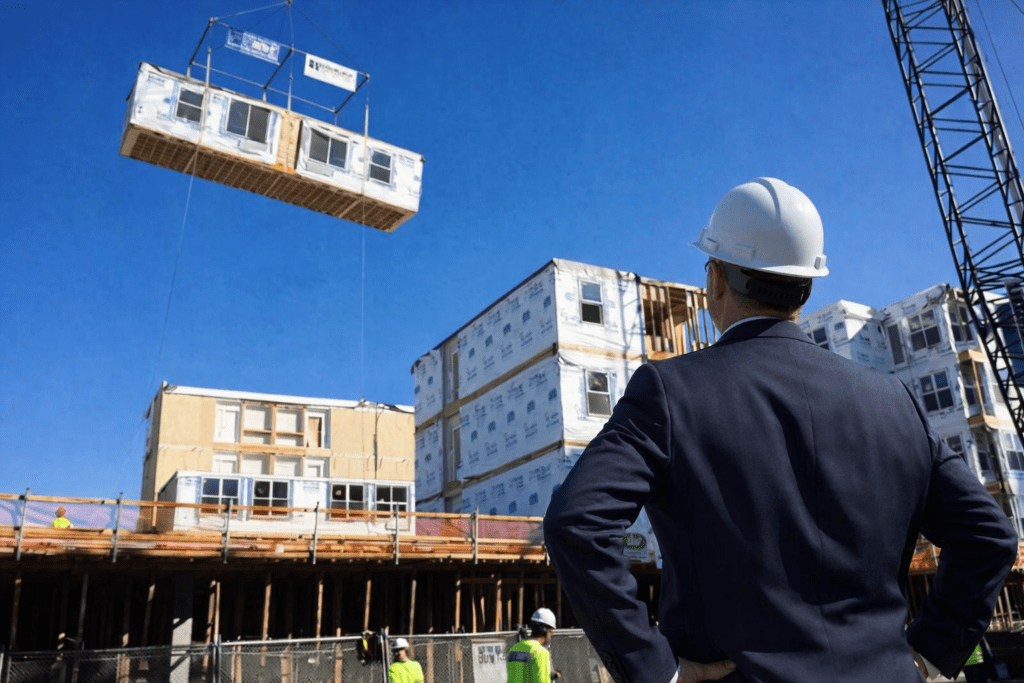
Modular construction is often viewed—especially by those new to it—as a process where a large portion of the building is delivered complete, set in place, and quickly turned into a finished product.
And to be fair, that’s part of the value. But it’s not the whole story.
A modular factory delivers a substantial portion of the structure. It can provide consistency, speed, and quality that are difficult to match in traditional site-built construction.
But the factory does not deliver a finished building ready for occupancy.
That final step—securing a Certificate of Occupancy—happens on the site.
And that’s where many developers underestimate the scope.
The Scope Gap
The issue I’ve seen most frequently is what I would call a “scope gap.”
Developers typically define the factory contract in detail—what is being built, how it is being built, and when it will be delivered.
But the work required on the site is often not defined with the same level of precision.
That gap will and does show up early. Much shows up later—when the project is nearing completion. This gap invariably leads to budgeted cost overruns and/or bad blood between the manufacturer and the builder/developer.
Questions begin to surface:
Who is responsible for the set crew?
Who is handling the final roofing?
Who is completing the fire-rated assemblies between modules?
Who is responsible for drywall finish at the marriage walls?
At that point, these are not simply planning questions. They are cost questions, and often, schedule problems.
Why This Matters
In modular construction, the factory operates on a controlled production schedule. Once production begins, modules move through the plant in a steady flow — or should!
The site, however, is far less controlled.
If the scope of site work is not clearly defined—if responsibilities are unclear, or if sequencing is not aligned with the factory schedule—the project begins to fall out of sync.
That misalignment is where problems begin.
Not because the modular concept doesn’t work, but because the full scope of the project wasn’t clearly understood from the start. Offsite construction is a system of processes and systems; they must be understood.
What Developers Should Be Asking
Developers considering modular construction should spend as much time defining the site scope required to achieve a Certificate of Occupancy as they do evaluating the factory.
Some of the most important early questions are:
• What exactly is the factory delivering—and just as importantly, what is it not delivering?
• What work must be completed on site before the building can be occupied?
• Who is responsible for each component of that work?
• Has that scope been clearly defined, scheduled, and budgeted?
These questions may not be as visible during a factory tour or not captured in the invoice.
But they are often far more important to the project’s success.
Understanding the Entire System
Modular construction can be an extremely effective solution when the entire process is understood and managed properly.
Factories can deliver speed, consistency, and efficiency. But they are only one part of the system.
Again I will state—-The project is not complete when the modules leave the factory.
It is complete when the building is finished, inspected, and approved for occupancy.
Developers who understand that distinction early will have a much greater possibility of a successful modular project.
Those who don’t, often learn it later—when changes are more difficult and more expensive.
Closing Thought
In the coming articles, I’ll give specific takeaways from experience-based lessons learned. Developers can evaluate modular manufacturers and prepare accurate, meaningful pro-formas in order to determine not only IF a particular manufacturer deserves their business but just as importantly—IS OFFSITE FEASIBLE AND THE CORRECT CHOICE?
In modular construction, success depends on more than just choosing the lowest factory invoice or even in choosing the right factory. It depends on understanding how the entire system comes together.

If you are serious about learning more about this, contact Gary at: [email protected], or Bill at:[email protected]. We’ll respond promptly and schedule a brief call.