

What My Father Taught Me About the Offsite Industry

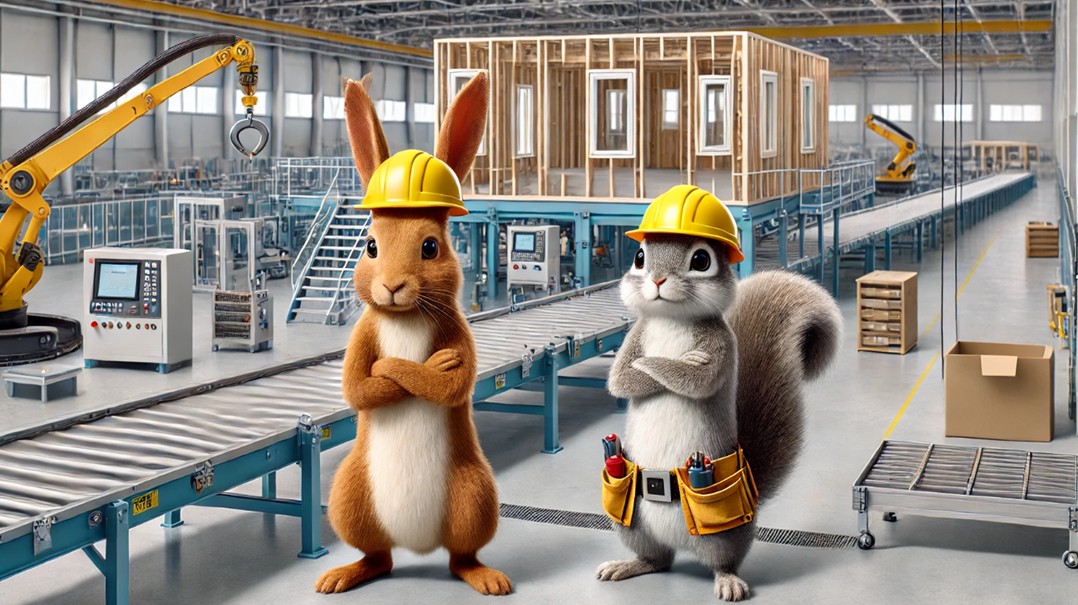
My father was a man of simple wisdom, the kind of person who could solve a business problem with a cup of coffee and a sentence that didn’t appear in any MBA textbook. Some fathers quote Churchill or Sun Tzu. Mine quoted wildlife.
He’d look at me over the dinner table, usually while slicing his meatloaf with the precision of a surgeon, and say:
“Rabbits and squirrels will always be prey.”
Now, when you’re twelve years old, this sounds less like business advice and more like the opening line of a National Geographic documentary. But as the years passed — and as I spent decades watching modular factories rise, fall, reopen, rebrand, collapse again, and blame it on the weather — his line started to make perfect sense.
And eventually I realized he wasn’t talking about animals.
He was talking about factory owners, developers, general managers, and sales reps.
Which honestly explains a lot.
So, in honor of my father — and the entire offsite construction ecosystem that behaves exactly like a forest filled with caffeine-addicted woodland creatures — here is your field guide to survival.
Bring binoculars.
The Rabbits: Fast, Cute, and Always About Five Minutes From Disaster
Ah yes, the rabbits — the most common species in the offsite forest. They hop into the industry full of optimism and high speed, certain they’ll revolutionize everything with their innovative floor plan, their “unique” marketing phrase, or their belief that builders love paying more for modules if you just explain it slowly.
Rabbits:
- sign contracts before calculating costs
- quote projects during full moons
- panic whenever interest rates move
- adopt new software every 90 days
- make major decisions before breakfast
They don’t build reserves. They don’t build systems. They don’t build predictable quoting. They build excitement.
Rabbits are the folks who say, “We’re going to triple production this year” and then six months later whisper, “We’re taking a little break while we reorganize.”
Rabbits don’t die because the market kills them.
Rabbits die because they trip over their own enthusiasm.
I’ve met hundreds of them. I’ve eaten donuts in their conference rooms. They bounce around like they’re powered by solar panels and anxiety. They move fast but have no idea where they’re going.
Cute? Absolutely.
Predators? Not a chance.
Snack-sized? Definitely.
The Squirrels: Nervous Hoarders with Spreadsheets
Squirrels are more cautious than rabbits. They hide their acorns, protect their acorns, inventory their acorns, count their acorns every quarter, and then discuss at the annual meeting whether they might buy one more acorn if the economy stabilizes.
A squirrel factory:
- hasn’t raised its base price since 2008
- still uses the same employee handbook from 2005
- thinks automation is “too risky”
- believes growth is suspicious
- views innovation the way a squirrel views a German Shepherd
Squirrels survive, but only because no one can find them long enough to kill them. They’ve mastered the art of being in business without standing out in business.
Squirrels attend conferences but sit in the back.
Squirrels listen to presentations about AI and robotics and mutter, “Not for us.”
Squirrels store cash but never deploy it.
They are competent. They are safe. They are consistent.
And Squirrels will absolutely be prey forever.
The Hawks: Specialists With Talons (and Real SOPs)
Now we’re finally getting somewhere.
Hawks are rare — which is why they thrive. They don’t try to build everything. They don’t chase every customer. They don’t reorganize their production line every Tuesday after watching a YouTube video about Toyota.
Hawks know who they are.
Maybe they’re the townhouse specialist.
Maybe they’re the ADU whisperer.
Maybe they’re the school-building savant.
Maybe they’ve mastered the art of building 14 different versions of the same 28×48 ranch without losing their mind.
Hawks fly higher than rabbits, meaning they can see trouble coming. They can also see opportunity forming before anyone else hears a rustle in the bushes.
Hawks do not panic.
Hawks do not hoard.
Hawks do not chase.
Hawks hunt.
Which means they are the natural predator of rabbits, squirrels, and — occasionally — undercapitalized bears.
The Wolves: Coordinated, Confident, and Capable of Actual Planning
If hawks are the specialists, wolves are the professional operators.
A wolf company doesn’t operate on hope, caffeine, or whatever inspirational quote was circulating on LinkedIn that week. Wolves operate on:
- systems
- training
- leadership
- process control
- actual job costing
- schedulers who enjoy color-coded spreadsheets
A wolf is a GM who knows exactly where every project stands, and when he doesn’t know, he actually asks — instead of hiding in his office until the crisis magically resolves itself.
I have walked into wolf factories. You can tell immediately.
No yelling.
No chaos.
No fires to put out.
No “Hank didn’t show up again, so we’re short.”
Wolves move in packs.
Sales, production, engineering, accounting, and leadership all move in the same direction.
You never see one wolf sprinting ahead while the rest claw at the ground trying to catch up.
The wolves are the ones who will quietly buy a struggling rabbit factory, keep the best employees, close the side door that’s been open since 2011, and turn the whole thing into a functional operation inside six months.
Wolves don’t brag.
They don’t make noise.
They don’t post in ALL CAPS on LinkedIn.
Wolves simply dominate.
The Bears: Enormous, Impressive, and Occasionally Unaware of Their Own Weight
Every few years, a massive new bear wanders into the modular forest wearing a hard hat, carrying a billion dollars, and announcing that they’re going to disrupt the entire industry by doing exactly what the industry has always done — but louder. Think Katerra, L&G, and Entekra.
Bears are impressive.
They attract headlines.
They attract investors.
They attract half the construction journalists on earth.
The problem is that bears also attract gravity.
And gravity has taken down more giant modular startups than any hawk or wolf ever has.
A bear can do enormous good.
A bear can also collapse in a spectacular pile of debt, ambition, and unused robotics.
The tricky part is that when a bear falls, it falls on everyone.
But that’s nature.
The woodland creatures scatter, and the survivors carry on with slightly more skepticism than before.
Where This Beautiful Woodland Disaster Leaves Us
My father didn’t say his line as a threat. He said it as a reminder:
If you behave like prey, you will live like prey.
If you behave like a predator, you will survive.
And that’s the offsite industry in a nutshell.
Some factories run like twitchy rabbits.
Some operate like nervous, hoarding squirrels.
Some soar like hawks.
Some coordinate like wolves.
Some lumber in like bears who haven’t read the instruction manual.
And somehow, all of them show up at industry conferences, sit at round tables, and nod politely while speakers talk about “transformation,” “innovation,” and “scaling responsibly.”
I sometimes wish a hawk, a squirrel, and a wolf would all sit on a panel and just explain their business models in wildlife terms. It might be the most honest session we’d ever have.
The Final Lesson in the Forest
After all these years, I can still hear my father’s voice whenever I talk to a factory, walk a production line, or get pulled into another discussion about why a startup needs $38 million before building its first prototype.
He’d say:
“Rabbits and squirrels will always be prey.”
He was right then.
He’s right now.
And if I had to guess, he’ll be right long after AI is managing factories, drones are delivering modules, and wolves are still shaking their heads at the rabbits who never learned.
The forest doesn’t lie. It just teaches.