Part 3 of the Offsite Innovators Business Transition Series
In the first two articles of this series, we looked at what creates value in an offsite manufacturing business and how buyers begin forming opinions long before they review financial statements or step onto the production floor.
Now it’s time to ask a more difficult question.
Is your business too dependent on you?
Some owners answer that question quickly. “No, my team handles most of the day-to-day operations.” The better question, however, is this:
Is the business running you, or are you running the business?


There is an important difference.
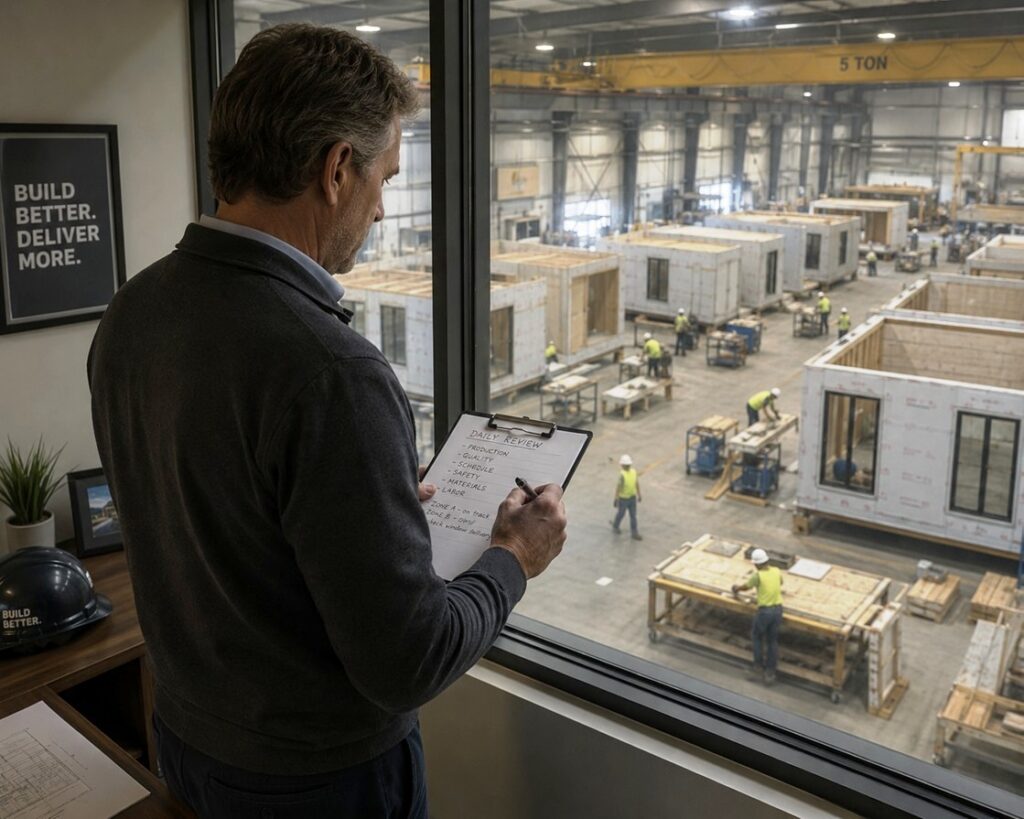
I’ve walked through manufacturing facilities where it becomes obvious within the first hour that every meaningful decision eventually finds its way back to the owner’s office. The phone rings constantly. Employees stop by with seemingly simple questions, with obvious answers. Department managers ask for approval on routine matters. Even while touring the production floor, line employees interrupt to ask where my prints, or where are these materials located? None of those interruptions seems significant by itself, but collectively they tell a very different story about how decisions are really being made throughout the organization.
THE OWNER HAS BECOME THE BOTTLENECK
Many owners wear those interruptions as a badge of honor. They believe being involved in every decision demonstrates commitment and leadership. It often demonstrates something else entirely.
If every purchasing decision requires the owner’s approval, does the purchasing manager really manage purchasing? If production supervisors can’t solve routine issues without finding the owner, are they truly leading production? If every customer concern, transportation issue, scheduling question, or personnel decision eventually reaches the owner’s desk, then the organization hasn’t delegated responsibility—it has simply distributed tasks.
Responsibility without authority isn’t leadership. It’s dependency, and dependency creates a business that revolves around one individual instead of a management team.
THE BEST-RUN BUSINESSES LOOK DIFFERENT
Well-managed businesses have interruptions too. Manufacturing is dynamic, and unexpected issues arise every day. The difference is that most of those issues are resolved by the people responsible for that department. Good owners don’t disappear from the business; they build an organization that knows how to function without requiring their constant involvement.
One of the first things I often ask to see is the organizational chart. Then I ask to meet the department heads. It’s a simple request, but it tells me a great deal about how the company is managed. On one recent visit, there were only two department heads to meet. That immediately raised questions about how decisions were being made throughout the rest of the organization.
Strong systems, meaningful management information, and capable department leaders don’t cause an owner to lose control of the business—they provide better control while requiring less direct involvement. Owners maintain a clear pulse on every department without becoming the heartbeat of the organization.
BUYERS NOTICE THIS IMMEDIATELY
Sophisticated buyers understand that the future value of a company depends on more than its financial performance. They’re evaluating whether the business can continue operating successfully after ownership changes. Importantly, will the current owner remain in place to allow a proper and comfortable transition.
Less experienced buyers often focus almost entirely on buildings, equipment, and financial statements. Those things certainly matter, but they don’t reveal whether the organization has the leadership depth to continue performing when the owner is no longer making every decision.
One question often reveals more than a stack of financial reports:
“If the owner disappeared for ninety days, what would happen?”
The answer tells buyers far more than most owners realize.
BUILDING VALUE MEANS BUILDING LEADERS
Every owner eventually reaches a point where working harder no longer solves the problem. Growth requires something far more difficult: trusting capable people, investing in experienced managers, and giving them both responsibility and the authority to make decisions.
That investment certainly increases overhead, but it also increases the long-term value of the business. Owners who understand that distinction aren’t simply building a company that performs well today—they’re building one that others will have confidence owning tomorrow.
THE BOTTOM LINE
Every phone call that only the owner can answer, every routine decision that waits outside the owner’s office, and every department that cannot function without approval quietly tells a buyer that the business depends on one person.
Owners often believe they’re making themselves indispensable. In reality, they may be making their business less valuable. The most valuable companies aren’t built around one individual. They’re built around capable people, sound systems, and leaders who have both the responsibility and the authority to make decisions.
Thinking About the Future of Your Offsite Business?
Whether you’re planning an ownership transition in the near future or simply want to build a stronger, more valuable company, the decisions you make today will shape your options tomorrow.
At Offsite Innovators, we help owners evaluate, prepare, and position their businesses for ownership transition. We’d welcome the opportunity for a confidential conversation about your business and the steps that can strengthen its long-term value.
..
..
..
..