I have a sneaking suspicion that if I walked into a room full of twenty- and thirty-something offsite construction startup founders and asked, “What does bootstrapping mean?” I’d probably be met with a few puzzled looks and someone quietly asking ChatGPT.
Ask that same group about PowerPoint, AI, pitch decks, venture capital, robotics, or digital twins, and the conversation would be off and running. There is absolutely nothing wrong with that. In fact, I use AI almost every day, and I genuinely believe it will transform our industry in ways we can’t yet imagine.
What concerns me isn’t the technology. It’s that somewhere along the way, the order of things seems to have changed. We used to build companies first and presentations second. Today, it sometimes feels like we build presentations first and hope the company eventually catches up.
When Bootstrapping Was Just Called Business
There was a time when no one talked about “bootstrapping.” It wasn’t a trendy startup philosophy or a chapter in an entrepreneur’s handbook. It was simply the way businesses got started.
If you wanted to own a modular factory twenty or thirty years ago, you looked for an opportunity that already existed. Maybe it was an older factory whose owner was ready to retire. Maybe it needed new equipment, a better sales strategy, or stronger leadership. Whatever its shortcomings, it was producing homes, employing people, and generating revenue.



You bought used equipment because new equipment was expensive. You hired experienced people because they knew things you didn’t. You watched every dollar because there wasn’t another investor waiting to write a larger check if things went sideways. Success wasn’t measured by how many people applauded your vision. It was measured by whether you could make payroll on Friday.
Nobody called that bootstrapping.
They simply called it running a business.
The Modern Startup Starter Kit
Today, I sometimes wonder if there’s an unofficial checklist for launching an offsite construction company.
Before you’ve built your first module, you should probably have a beautifully designed website, an inspiring mission statement filled with words like transformative, disruptive, and ecosystem, a LinkedIn page announcing you’ve emerged from stealth mode, several AI-generated renderings of neighborhoods that don’t yet exist, and, of course, a PowerPoint presentation polished to within an inch of its life.
If you’re really ambitious, you should probably have a valuation that exceeds companies that have been shipping homes for decades.
I’m exaggerating…
…but not by much.
The Seduction of the Perfect Pitch
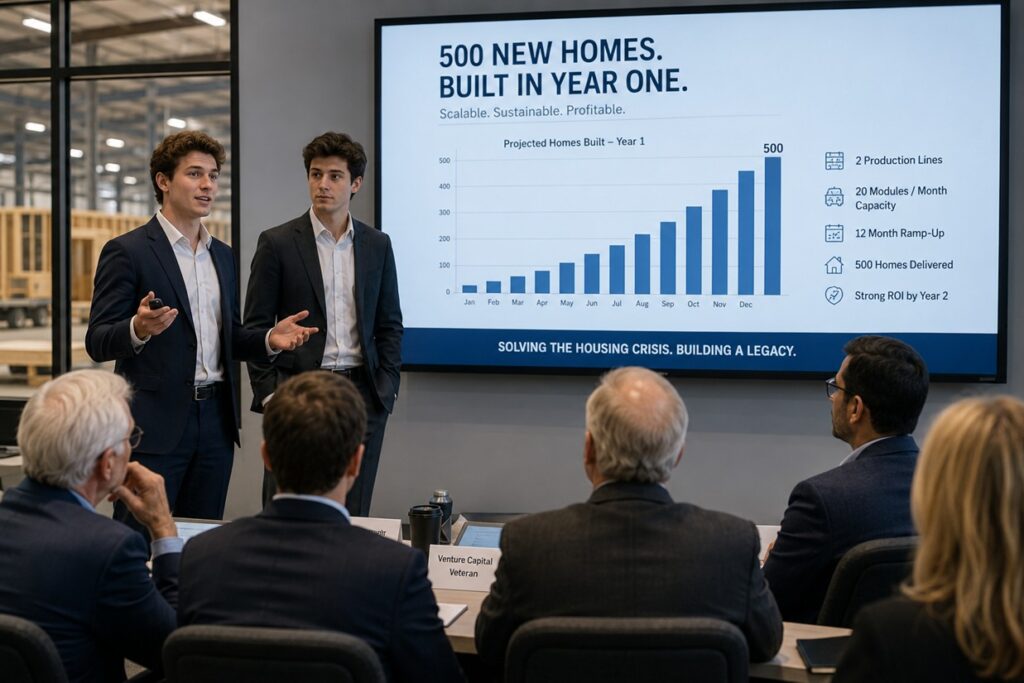
Over the years, I’ve sat through presentations that were genuinely impressive. The graphics were stunning. The market projections climbed steadily upward. The founders spoke confidently about changing the housing industry forever.
Then I’d ask a few simple questions.
“Where’s your factory?”
“We’re still evaluating locations.”
“How many homes have you built?”
“We’re pre-revenue.” (I actually heard that for the first time at this year’s IBS)
“Who’s running production?”
“We’re interviewing candidates.”
By this point, I’m never quite sure whether I’m talking with a manufacturing startup or watching auditions for the next season of Shark Tank.
A polished presentation can create excitement, but excitement isn’t the same as execution.
The Opportunity Sitting Right in Front of Us
One of the great mysteries to me is why so many startup teams insist on building everything from scratch while quietly ignoring factories that already exist.
Across North America are modular factories owned by people approaching retirement. Some need modernization. Others need fresh marketing, new leadership, updated production systems, or additional capital. Nearly all of them represent something that no PowerPoint presentation can offer.
They have customers.
They have employees.
They have supplier relationships.
They have production history.
Most importantly, they’ve already survived the countless challenges that come with actually building homes.
An operating factory may not photograph as well as a sleek architectural rendering, but it offers something infinitely more valuable: proof that the business works.
Possibility Versus Proof
I understand why investors become captivated by big ideas. Every investor hopes to discover the next revolutionary company that changes an industry forever. Vision is exciting. Innovation attracts attention. Bold predictions make headlines.
Reality is considerably less glamorous.
Reality means production delays.
Reality means warranty calls.
Reality means equipment breakdowns on a Tuesday morning.
Reality means customers changing specifications after production has already started.
Reality means finding a way to make payroll even when three employees call in sick and a supplier misses a delivery.
None of those things fit neatly onto a PowerPoint slide, yet they’re exactly where successful manufacturing companies earn their reputation.
AI Isn’t Replacing Experience
Before anyone accuses me of becoming the old guy complaining that things were better “back in my day,” let me be perfectly clear.
I love AI.
I use ChatGPT—whom I call Chad—every single day. It has made me a better writer, researcher, and editor. Robotics will continue changing manufacturing. Artificial intelligence will improve design, planning, scheduling, and countless other processes throughout the offsite industry.
Technology isn’t the problem.
The problem begins when we mistake technology for experience or confuse a convincing presentation with proven execution.
No matter how sophisticated the software becomes, it still can’t replace the lessons learned by shipping hundreds—or thousands—of homes.
Maybe We’ve Been Asking the Wrong Question
Imagine walking into an investor meeting carrying two items.
In one hand is a beautifully crafted 75-slide PowerPoint explaining how your company will revolutionize housing.
In the other is the financial statement from a modest modular factory that quietly shipped 400 homes last year while earning a profit.
One represents possibility.
The other represents proof.
Both have value, but if I were investing my own money, I know which one I’d study first.
Gary’s Observation

I sometimes think the younger generation believes bootstrapping is an app they haven’t downloaded yet. That’s not a criticism; it’s simply a reflection of how entrepreneurship has evolved. They’ve grown up in a world where startup culture celebrates funding rounds, polished presentations, and bold announcements. My generation grew up believing you proved your idea by making something people would actually buy.
CLICK HERE for a FREE Consultation about starting or operating your offsite factory
The offsite construction industry absolutely needs fresh thinking, AI, robotics, automation, and entrepreneurs willing to challenge old assumptions. But perhaps it’s also time to rediscover one of the oldest startup principles of all.
Instead of asking, “Can I see your PowerPoint?”
Maybe we should start asking, “Can I see your production line?”
.
.
..
.
.
.
.
.
.
.
…