Part 2 of Offsite Innovators’ Business Transition Series
In the first article in this series, I suggested that the value of an offsite manufacturing business is
determined by far more than its building, equipment, or production capacity. That observation
generated some thoughtful conversations because many owners naturally focus on the tangible
assets they can see and measure.
After more than forty years leading, evaluating, and advising offsite manufacturing companies,
I’ve learned that experienced buyers begin evaluating a business long before they review
financial statements or walk onto the production floor. Their impressions often begin forming
within the first few minutes of arriving on the property.
That’s because your business starts talking before you do.
Some businesses project organization, confidence, and discipline from the moment you arrive.
Others communicate something entirely different. Most owners don’t even realize it’s happening
because they see the same surroundings every day, while a prospective buyer sees everything
with a fresh set of eyes. Those first impressions won’t determine whether a business ultimately
sells, but they often influence how buyers perceive the company before the real due diligence
even begins.
FIRST IMPRESSIONS AREN’T JUST FOR HOMES
When people prepare to sell a home, they understand the importance of first impressions. They
mow the lawn, touch up the paint, and straighten the furniture because they know buyers begin
forming opinions the moment they pull into the driveway. Businesses are no different.
As I arrive at a manufacturing facility, I’m already making observations. Is the property
maintained? Does the office project professionalism? Is someone there to greet visitors, or does
everyone seem surprised that someone has walked through the front door? I notice whether the
receptionist (if there is one) is engaged and welcoming, whether the office is organized, and
whether the owner’s office reflects order or constant firefighting. I also notice whether the owner
is prepared for our meeting or is repeatedly interrupted by phone calls and employees needing
decisions that only he or she can make.
None of those observations determines the value of the business by itself. Collectively, however,
they begin telling a story long before anyone discusses production, profitability, or financial
performance.
THEN THE PLANT JOINS THE CONVERSATION
Eventually we walk into the factory.
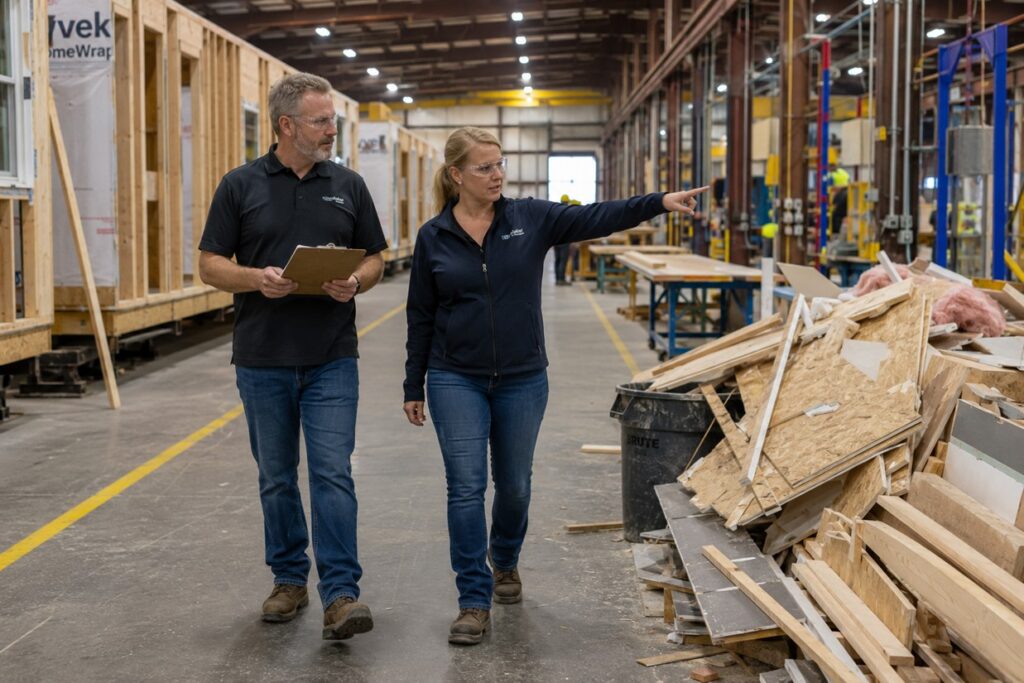
I don’t expect a modular manufacturing plant to look like an operating room. Lumber creates
sawdust, production creates noise, and manufacturing is active by its very nature. But there is a
tremendous difference between a busy operation and a disorganized one.
Within a few minutes, I begin watching the production flow. Are crews working steadily, or are
they waiting for material? Does work move smoothly from station to station, or are bottlenecks
obvious? Is the production line balanced, or do certain departments seem overwhelmed while
others wait? I pay attention to whether supervisors are leading production or simply spending the
day putting out fires. I also notice whether materials are staged where they’re needed, whether
damaged materials are accumulating, and whether rework appears to be routine rather than the
exception.
None of these observations is intended as criticism. Together, however, they provide a
remarkably accurate picture of how the operation is managed, and they tell me far more about
the business than any inventory of equipment ever could.
OWNERS AND BUYERS SEE DIFFERENT THINGS
One of the most interesting parts of any plant tour is listening to what owners naturally want to
show me. They proudly point out a unique project on the production line, a recently purchased
machine, or a new process they’ve developed. Those accomplishments deserve recognition
because they often represent years of hard work, investment, and pride in what they’ve built.
Experienced buyers, however, tend to ask very different questions. They want to know how
many people are on the production line, which departments are difficult to staff, whether
overtime has become routine, and how dependent the business is on the owner. Their questions are less about today’s project and more about whether the business can consistently perform long after the current owner has moved on.
That’s the difference between admiring what has been built and evaluating what can be sustained.
EVERY BUSINESS LEAVES CLUES
Successful businesses leave clues everywhere, although owners often stop noticing them because they see the same operation every day. Visitors don’t have that luxury. They notice how employees interact, whether supervisors appear to be leading or simply reacting, how
information moves through the organization, and whether materials are organized or constantly
being moved from one place to another.
No single observation determines the value of a company. Collectively, however, they paint a
remarkably accurate picture of how the business is managed and how likely it is to continue
performing after a change in ownership. That is precisely what serious buyers are trying to
determine before they ever begin negotiating terms.
THE BOTTOM LINE
Financial statements matter. Equipment matters. Real estate matters. Every experienced buyer
expects those assets to be evaluated carefully. But long before spreadsheets are opened or
appraisals are discussed, another evaluation has already begun.
Buyers are quietly asking themselves whether this feels like a business they would be
comfortable owning. They’re observing how people work together, how decisions are made, and
whether the organization appears disciplined, organized, and capable of succeeding without
constant intervention from the owner. Those impressions don’t replace due diligence, but they
shape it. They influence the questions buyers ask, the risks they perceive, and ultimately the
confidence they have in the business they’re considering.
By the time everyone gathers around the conference table, your business has already been
speaking for quite some time. The only question is whether buyers like what they’ve heard.
Thinking About the Future of Your Offsite Business?
Whether you’re considering selling in the near future or simply want to build a more valuable
company, the decisions you make today will determine the opportunities you have tomorrow.
At Offsite Innovators, we help owners evaluate, prepare, and position their businesses for
business and ownership transition. If you’d like a confidential conversation about where your
business stands today—and what steps might strengthen its future—we’d welcome the
opportunity to talk with you.
Next in the Offsite Innovators Business Transition Series
What Buyers Really Buy
..