Panelized construction has matured beyond speed and labor savings. Today’s buyers—builders, developers, and increasingly regulators—are asking harder questions: How does it perform? How does it age? How does it behave in fire, moisture, and extreme climates?
That’s where the comparison between EPS-core panels and PUR-core Eco-Panels becomes more than a technical debate. It becomes a discussion about risk, predictability, and long-term building performance.
Panels may look similar from the outside, but what’s inside them tells a very different story.
EPS Panels: Proven, Familiar, and Widely Understood
Expanded Polystyrene (EPS) has been the dominant foam core in SIPs for decades—and for good reason. It’s lightweight, affordable, widely available, and well understood by code officials. EPS panels have helped thousands of builders improve energy performance compared to traditional framing, and in many markets they remain a solid step forward from site-built assemblies.
But EPS is still a compromise material.


Its R-value per inch is modest compared to newer foams, which means thicker panels are required to achieve higher performance targets. EPS is also more vulnerable to thermal degradation over time, moisture absorption at cut edges, and lower fire resistance without added protective layers. In short, EPS panels work—but they leave performance on the table.
As energy codes tighten and expectations rise, that gap matters.
PUR Foam: The Performance Multiplier Inside Eco-Panels
Polyurethane (PUR) foam is where panelized construction crosses a threshold—from “better than average” to engineered performance.
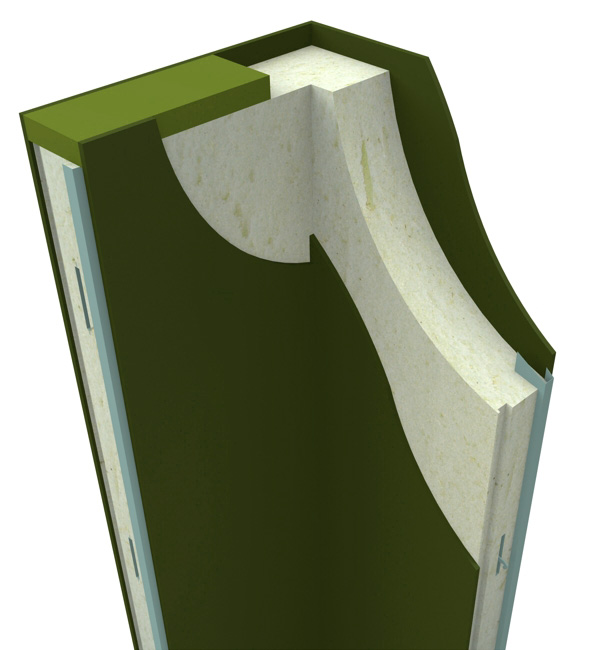
PUR panels from Eco-Panels deliver a significantly higher R-value per inch than EPS, allowing Eco-Panels to achieve superior thermal performance without increasing wall thickness. That alone has ripple effects: slimmer assemblies, more usable interior space, and easier detailing around windows, doors, and connections.
But insulation value is only part of the story.
PUR foam forms a denser, more uniform core with exceptional adhesion to panel skins. That improves structural behavior, reduces thermal bridging, and enhances air tightness across the entire assembly. In practical terms, it means fewer leaks, fewer surprises at blower door testing, and more consistent real-world energy performance.
Fire Performance: Where the Difference Becomes Impossible to Ignore
Fire behavior is one of the most under-discussed differentiators between foam cores—and one of the most important.
PUR foam, especially when combined with non-combustible skins such as MgO, offers dramatically improved fire resistance compared to EPS. Flame spread is lower. Smoke development is reduced. Assemblies maintain integrity longer under fire exposure.
For multi-family, commercial, and urban infill projects—where fire ratings are no longer optional—this advantage alone can determine whether a system is approved or rejected.
EPS systems can meet fire requirements, but often only through additional layers, coatings, or assemblies that add cost, complexity, and installation risk. PUR-based Eco-Panels are engineered from the start to meet these demands as a system, not as an afterthought.
Moisture, Durability, and Long-Term Stability
EPS can absorb moisture at exposed edges and penetrations, which can degrade thermal performance over time if detailing or site conditions are less than perfect. PUR foam, by contrast, has far lower water absorption and maintains its insulating properties even in challenging environments.
That matters for real buildings—not lab tests.
Eco-Panels using PUR are better suited for high-humidity regions, coastal zones, and climates where temperature swings and moisture exposure punish marginal assemblies. Over decades, that stability translates into fewer envelope failures, fewer remediation projects, and more predictable lifecycle costs.
Manufacturing Precision vs. Field Compensation
EPS panels often rely on thickness, redundancy, or field-applied solutions to compensate for material limitations. PUR-based Eco-Panels rely on manufacturing precision instead.
Because PUR delivers higher performance in thinner, denser cores, factories can control tolerances more tightly, integrate layers more effectively, and reduce reliance on jobsite corrections. The result is a panel that behaves the same way on day 1,000 as it did on day one.
This is the quiet advantage manufacturers care about most: repeatability.
The Bigger Picture: Panels as Risk Management
Choosing PUR-core Eco-Panels over EPS isn’t just about better insulation numbers. It’s about reducing uncertainty.
Higher thermal efficiency means smaller mechanical systems. Better fire resistance means fewer approval hurdles. Lower moisture sensitivity means fewer long-term failures. And tighter factory control means fewer site-level variables.
EPS panels helped the industry take its first step away from stick framing. PUR-based Eco-Panels represent the next step—where panelization isn’t just faster, but smarter, safer, and built for the regulatory and climate realities ahead.
In today’s construction environment, that difference isn’t academic.
It’s strategic.

Gary Fleisher—known throughout the industry as The Modcoach—has been immersed in offsite and modular construction for over three decades. Beyond writing, he advises companies across the offsite ecosystem, offering practical marketing insight and strategic guidance grounded in real-world factory, builder, and market experience.